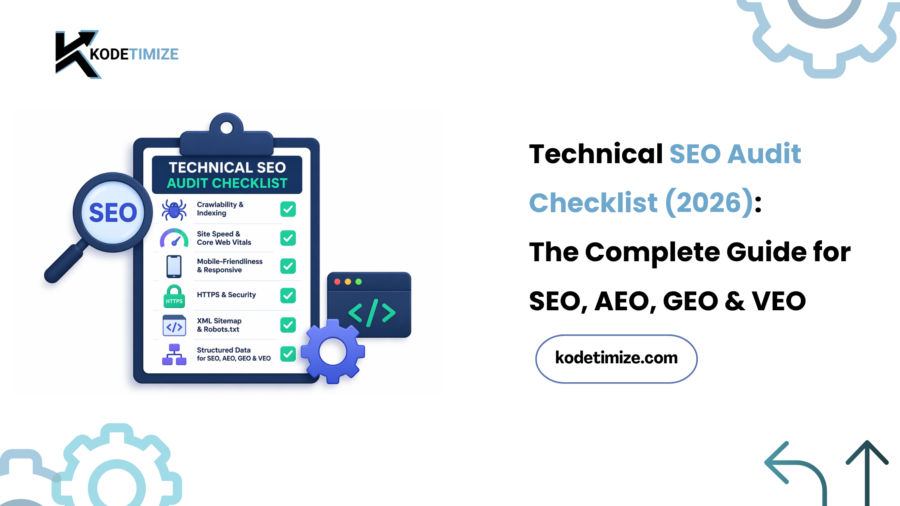
Technical SEO Audit Checklist (2026): The Complete Guide for SEO, AEO, GEO & VEO

Technical SEO Audit Checklist (2026): The Complete Guide for SEO, AEO, GEO & VEO

You could have the best content on the internet. You could have backlinks from every major publication. But if your technical foundation is broken, none of it matters — Google, ChatGPT, Gemini, and Perplexity simply won’t serve your pages to users.

A technical SEO audit in 2026 is no longer just about fixing crawl errors. It is about engineering a website that is simultaneously readable by Google’s traditional crawlers, extractable by AI answer engines, synthesizable by LLMs, and audible to voice assistants.

This is the most comprehensive technical SEO audit checklist you’ll find for 2026 — built after analyzing the top-ranking guides, identifying their content gaps, and adding what they miss: AEO, GEO, VEO, and the latest Google rendering updates.

Here is exactly what this guide covers:

  • ✅ Crawlability & Indexability Audit
  • ✅ Site Architecture & URL Structure
  • ✅ Core Web Vitals (LCP, INP, CLS) — 2026 benchmarks
  • ✅ Mobile-First & Rendering Audit
  • ✅ Structured Data & Schema Markup
  • ✅ Security & HTTPS
  • ✅ Duplicate Content & Canonicalization
  • ✅ JavaScript SEO & Log File Analysis
  • ✅ Internal Linking & Crawl Budget
  • ✅ AEO (Answer Engine Optimization) Checklist
  • ✅ GEO (Generative Engine Optimization) Checklist
  • ✅ VEO (Voice Engine Optimization) Checklist
  • ✅ AI Search Readiness Audit
  • ✅ Tools You Need
  • ✅ Audit Frequency Schedule

What Is a Technical SEO Audit?

A technical SEO audit is a structured, comprehensive examination of your website’s technical infrastructure. Its purpose is to identify any element that prevents search engines — and increasingly, AI systems — from crawling, rendering, understanding, and indexing your content.

Think of it as a full-body health scan for your website. It doesn’t look at your writing style or your backlink count. It looks at the pipes, the wiring, and the foundation — the invisible layer that determines whether your content gets seen at all.

In 2026, a proper technical audit covers three layers:

  1. SEO Layer — Can Google find, crawl, and rank your pages?
  2. AEO/GEO Layer — Can AI systems extract, cite, and summarize your content?
  3. VEO Layer — Can voice assistants deliver your answers to spoken queries?

Skip any layer and you’re leaving visibility on the table.

Why Technical SEO Audits Matter More in 2026 Than Ever Before

Search changed fundamentally in 2025–2026. Here’s what’s different now:

Google’s December 2025 Rendering Update clarified that pages returning non-200 HTTP status codes (404s, 5xx errors) may be excluded from the rendering pipeline entirely. If your JavaScript-heavy site serves “friendly” error pages with a 200 OK status, Googlebot may never discover the real issue — and your pages won’t get rendered.

INP replaced FID as a Core Web Vital in March 2024, and in 2026, INP is now a decisive ranking signal. Many sites that haven’t updated their auditing process are still checking FID — and flying blind.

AI Overviews now appear in over 40% of Google search results. ChatGPT, Perplexity, and Gemini drive millions of referral visits monthly. If your content isn’t structured for AI citation, you’re invisible in the fastest-growing discovery channel.

The March 2026 Core Update hit sites hardest in two areas: thin E-E-A-T signals and poor AEO/GEO readiness. Traditional technical SEO scores alone didn’t predict recovery — AI-readiness did.

The bottom line: technical SEO is no longer the foundation beneath your strategy. It is your strategy.

Part 1: Crawlability & Indexability Audit

✅ 1. Check Your robots.txt File

Your robots.txt file controls which pages search engines can access. Misconfiguration here can accidentally block your entire site.

What to check:

  • Open yoursite.com/robots.txt in your browser
  • Confirm that key pages, CSS files, and JavaScript resources are NOT blocked
  • Ensure you haven’t used robots.txt as an indexing strategy — use noindex tags for that instead (Google explicitly does not support the noindex directive inside robots.txt)
  • Check that crawlers you want to allow (Googlebot, Bingbot, GPTBot, Claude-Web, PerplexityBot) are not disallowed

Pro tip for 2026: If you want to appear in AI-generated answers powered by Gemini, ensure you haven’t blocked Googlebot-Extended. Also consider whether you want to allow GPTBot and PerplexityBot — blocking them removes you from those AI platforms entirely.

Tool: Google Search Console → Settings → robots.txt Tester

✅ 2. Audit Your XML Sitemap

Your sitemap is the roadmap you hand directly to search engines. A stale or incorrect sitemap wastes crawl budget.

What to check:

  • Does your sitemap exist at yoursite.com/sitemap.xml?
  • Is it submitted in Google Search Console and Bing Webmaster Tools?
  • Does it include only indexable URLs (no noindex pages, no blocked pages)?
  • Are lastmod timestamps accurate and only updated when meaningful content changes occur?
  • For large sites, is it split into logical sub-sitemaps (posts, pages, products)?

Tool: Google Search Console → Sitemaps Report

✅ 3. Review the GSC Index Coverage Report

Google Search Console’s Index Coverage report is your ground truth for indexing health.

What to check:

  • Pages marked as “Excluded” — understand why each one is excluded
  • Pages with “Crawl anomalies” or “Server errors”
  • Pages marked as “Discovered — currently not indexed” — these are pages Google found but hasn’t prioritized. This usually signals thin content or crawl budget issues.
  • Pages where “noindex” is applied but shouldn’t be

Priority fix: Any page that should be indexed but shows as “Excluded” or “Crawl anomaly” is a direct ranking blocker. Fix these first.

✅ 4. Check for Orphan Pages

Orphan pages have no internal links pointing to them. Search engines discover them either through the sitemap or not at all — and they receive zero link equity.

What to check:

  • Export all indexed URLs from Google Search Console
  • Run a Screaming Frog crawl and compare crawled URLs against the GSC export
  • Any URL in GSC that Screaming Frog didn’t find via crawl = orphan page

Fix: Add contextual internal links to orphan pages from your highest-authority pages, or remove them if they serve no purpose.

✅ 5. Verify Canonical Tags

Canonical tags tell search engines which version of a page is the “master” version. Wrong or missing canonicals create duplicate content chaos.

What to check:

  • Every page has a self-referencing canonical tag
  • Paginated pages use correct canonicals (do NOT canonical page 2 to page 1 — this hides content)
  • HTTPS and HTTP versions canonicalize correctly to HTTPS
  • www and non-www versions are unified
  • Parameter-based URLs (e.g., ?sort=price) canonical to the clean URL

Tool: Screaming Frog → Canonicals Tab

Part 2: Site Architecture & URL Structure

✅ 6. Audit URL Structure

URLs are a ranking signal and a usability signal. In 2026, clean, descriptive URLs are also easier for AI systems to parse.

What to check:

  • URLs are short, descriptive, and keyword-rich
  • No underscores (use hyphens)
  • No unnecessary parameters, session IDs, or dynamic strings
  • URL depth: key pages should be reachable within 3 clicks from the homepage
  • No duplicate URLs with different capitalization (Google treats these as different pages)

Good example: yoursite.com/technical-seo-audit-checklist/ Bad example: yoursite.com/p=1234?cat=seo&sort=new

✅ 7. Fix Redirect Issues

Redirect chains and redirect loops drain crawl budget and dilute link equity.

What to check:

  • Eliminate redirect chains (A → B → C). Make A → C directly.
  • Ensure redirects preserve intent: a category page should redirect to a category page, not the homepage
  • Use 301 for permanent redirects; 302 for temporary
  • Fix all 404 errors on pages that have received backlinks — redirect them with 301s

Tool: Screaming Frog → Response Codes → 3xx + 4xx filter

✅ 8. Internal Linking Audit

Internal linking distributes authority, guides crawlers, and signals topical relevance to AI systems.

What to check:

  • Every important page receives internal links from at least 3–5 relevant pages
  • Anchor text is descriptive and keyword-rich (not “click here”)
  • No broken internal links (404s)
  • Pages with the most internal links match your revenue-generating or highest-priority content
  • No excessive pagination dependence — navigation and category discovery should not rely on JavaScript scroll events

Pro tip for 2026: Internal linking is one of the strongest GEO signals. AI systems follow link structure to understand your content hierarchy. Pages with strong internal link clusters are more likely to be cited as authoritative sources in AI-generated answers.

Part 3: Core Web Vitals (2026 Benchmarks)

Core Web Vitals are a confirmed Google ranking signal. In 2026, these three metrics define your site’s performance health:

✅ 9. LCP — Largest Contentful Paint (Target: Under 2.5 seconds)

LCP measures how quickly the largest visible element (usually a hero image or H1) loads on screen.

What to check:

  • Run Google PageSpeed Insights on your homepage, top landing pages, and product/category pages
  • Is your hero image served in WebP or AVIF format?
  • Is lazy loading not applied to above-the-fold images? (Lazy loading above-the-fold images delays LCP)
  • Is server response time (TTFB) under 600ms?
  • Have you set fetchpriority="high" on your LCP image?
  • Are you using a CDN to serve images close to the user?

✅ 10. INP — Interaction to Next Paint (Target: Under 200ms)

INP replaced FID in March 2024 and is the primary responsiveness metric in 2026. Many auditing guides and tools still show FID — this is outdated. Check INP.

INP measures how quickly the page responds after a user interacts (click, tap, keypress).

What to check:

  • Use Chrome DevTools → Performance panel → Look for long tasks on the main thread
  • Audit and defer non-critical third-party scripts (chat widgets, analytics, ad scripts)
  • Reduce JavaScript execution time
  • Break up long tasks into smaller async chunks
  • Avoid forced synchronous layouts

Tool: PageSpeed Insights (Field Data section) + Chrome UX Report

✅ 11. CLS — Cumulative Layout Shift (Target: Under 0.1)

CLS measures how much your page “jumps around” as it loads. Poor CLS frustrates users and signals poor UX to Google.

What to check:

  • All images and video embeds have explicit width and height attributes defined in HTML
  • No dynamically injected ads or banners that push content down
  • Web fonts use font-display: swap to prevent FOIT (Flash of Invisible Text)
  • No late-loading popups or banners that appear above existing content

Part 4: Mobile-First & Rendering Audit

✅ 12. Mobile-First Indexing Check

Google has indexed the web mobile-first for years — yet many developers still audit with desktop user agents. This is a critical mistake in 2026.

What to check:

  • Validate all high-value crawls using the Googlebot Smartphone user agent in Screaming Frog
  • Verify with Google Search Console’s Mobile Usability report
  • Ensure no content is hidden on mobile that exists on desktop (Google only sees the mobile version)
  • Tap targets are at least 48px × 48px
  • Text is readable without zooming (minimum 16px font size)

Tool: Google Search Console → Mobile Usability Report + Google’s Mobile-Friendly Test

✅ 13. JavaScript SEO & Rendering Audit

JavaScript-heavy sites (React, Vue, Next.js, Angular) introduce SEO risks that purely HTML sites don’t face.

What to check:

  • Critical content (main body text, H1, internal links) is present in the initial HTML response — not loaded after hydration
  • Check by disabling JavaScript in Chrome DevTools and viewing the page source: does the important content appear?
  • Avoid the “Invisible 500 Error” — when a server error is caught by the client framework and served as a 200 OK. Googlebot will see a thin page and may de-index it.
  • Single Page Applications (SPAs): ensure your server returns true 404 status codes for missing pages — not a 200 OK shell that renders an error component via JavaScript
  • Ensure pagination and category navigation is crawlable via static HTML links, not JavaScript scroll events

2026 rule: Your most important content must exist in the initial HTML or SSR output — especially article bodies, product descriptions, navigation menus, and price information.

Local SEO Checklist for Indian Businesses 

Your Google Business Profile (GBP) is the single most powerful local ranking asset you have. According to Whitespark’s 2026 Local Search Ranking Factors survey, GBP signals account for 32% of local ranking weight — second only to proximity. The steps below are ordered by impact.

Part 5: Structured Data & Schema Markup

✅ 14. Implement and Validate Schema Markup

Schema markup helps search engines understand your content precisely — and it is one of the most direct ways to improve AI citation likelihood.

Priority schema types by site type:

Site TypeMust-Have Schema
Blog / PublisherArticle, BreadcrumbList, Author, FAQPage
E-commerceProduct, Offer, Review, BreadcrumbList
Local BusinessLocalBusiness, OpeningHours, GeoCoordinates
SaaS / ServiceOrganization, Service, FAQPage, HowTo
Recipe / FoodRecipe, NutritionInformation

What to check:

  • Validate all schema using Google’s Rich Results Test and Schema.org Validator
  • No schema errors or warnings in Google Search Console → Enhancements
  • Author schema includes sameAs links to social profiles (strengthens E-E-A-T signals)
  • Organization schema includes sameAs links to Wikipedia, Wikidata, LinkedIn (strengthens entity clarity for AI systems)
  • FAQPage schema matches the exact FAQ content visible on the page
  • Product schema includes price, availability, and review properties

Tool: Google Rich Results Test (search.google.com/test/rich-results)

✅ 15. Implement HowTo & FAQ Schema for AEO

FAQ and HowTo schema are the most powerful AEO signals you can add to a page. They directly format your content for AI answer extraction.

What to check:

  • Every key informational page has FAQPage schema with 4–8 questions covering common user queries
  • Questions match exactly what users search for (use Google’s “People Also Ask” for inspiration)
  • Answers are complete, direct, and under 300 words each — AI systems prefer concise, standalone answers
  • HowTo schema is used for any process, checklist, or step-by-step content

Part 6: Security & HTTPS

✅ 16. HTTPS Audit

HTTPS is a baseline ranking signal. Any HTTPS misconfiguration is a trust killer with both search engines and users.

What to check:

  • All pages load over HTTPS — no HTTP pages
  • SSL certificate is valid and not expired (check via SSL Labs: ssllabs.com/ssltest/)
  • No mixed content errors (HTTP resources loading on HTTPS pages)
  • HSTS (HTTP Strict Transport Security) header is implemented
  • HTTP → HTTPS redirects are in place for every URL

Tool: SSL Labs + Chrome DevTools → Security Tab

✅ 17. Security Headers Audit

Security headers are increasingly treated as trust signals by both Google and AI systems evaluating page credibility.

What to check:

  • X-Content-Type-Options: nosniff is set
  • X-Frame-Options: SAMEORIGIN is set (prevents clickjacking)
  • Content-Security-Policy is configured
  • Referrer-Policy is set

Tool: securityheaders.com

Part 7: Duplicate Content & Canonicalization

✅ 18. Identify & Fix Duplicate Content

Duplicate content dilutes ranking signals and confuses search engines about which version to rank.

Common duplicate content sources:

  • WWW vs. non-WWW versions
  • HTTP vs. HTTPS versions
  • Trailing slash vs. no trailing slash (yoursite.com/page/ vs. yoursite.com/page)
  • URL parameters (session IDs, tracking parameters)
  • Printer-friendly page versions
  • Paginated pages

What to check:

  • Pick one canonical URL format and redirect all variations to it
  • Use canonical tags on all product/category pages with filter parameters
  • Implement ?ref=, ?utm_source= and other tracking parameters in Google Search Console as “URL Parameters” to prevent indexing

Tool: Screaming Frog → Duplicates Tab

✅ 19. Content Pruning

Not all pages deserve to be indexed. Thin, outdated, or low-traffic pages dilute your site’s overall authority signal.

What to check:

  • Export all indexed URLs and cross-reference with Google Analytics
  • Pages with zero organic sessions in the past 12 months are candidates for pruning
  • Options: improve the content, merge with a related page (301 redirect), or apply noindex
  • Thin tag pages, date archive pages, and empty category pages should be noindexed by default

Part 8: Log File Analysis

✅ 20. Analyze Server Log Files

Server logs reveal exactly how Googlebot interacts with your site — information Google Search Console delays or omits.

What to check:

  • Which pages does Googlebot crawl most frequently?
  • Are there pages being crawled that waste crawl budget (thin pages, parameter URLs, staging URLs)?
  • Are your most important pages being crawled at the frequency you expect?
  • Are any 500 errors appearing that GSC hasn’t flagged yet?

Tool: Screaming Frog Log File Analyser, Splunk, or custom log parsing with Python

2026 note: Log file analysis is particularly important for JavaScript-heavy sites and large e-commerce platforms where GSC data is often delayed or incomplete.

Part 9: AEO — Answer Engine Optimization Checklist

Answer Engine Optimization (AEO) is the practice of structuring your content so it can be cleanly surfaced by AI-driven answer interfaces — including Google AI Overviews, featured snippets, and conversational AI platforms.

✅ 21. Write Direct Answer Openings (BLUF Method)

The BLUF method (Bottom Line Up Front) means your most important answer appears in the first 1–2 sentences of each section.

Example: ❌ “In this section, we will discuss what a technical SEO audit is and why it matters for your website in 2026…” ✅ “A technical SEO audit is a structured examination of your website’s infrastructure to identify issues preventing search engines from crawling, rendering, and indexing your content.”

AI systems are trained to extract direct, standalone answers. Content that buries the answer is content that gets skipped.

✅ 22. Use Question-Based H2 and H3 Headers

Structure your headers as the exact questions your audience asks. AI systems use heading hierarchy as answer extraction signals.

Good examples:

  • “What Is a Technical SEO Audit?”
  • “How Often Should I Run a Technical SEO Audit?”
  • “What Are Core Web Vitals in 2026?”

✅ 23. Add FAQPage Schema to Every Key Post

As covered in the schema section — FAQPage schema is the most direct AEO signal you can implement. Every informational blog post should include 5–10 questions directly answering common user queries about the topic.

✅ 24. Use Tables and Comparison Blocks

AI systems — and featured snippets — heavily favor tabular data. For any comparison, checklist, or metric-based content:

  • Use HTML <table> elements with clear column headers
  • Use definition lists for glossary-style content
  • Use numbered lists for step-by-step processes

✅ 25. Build Topic Clusters for AEO Authority

AI answer engines don’t just evaluate individual pages — they evaluate your site’s topical depth. A site with 30 interlinked, authoritative posts on technical SEO will be cited more reliably than a single post, even if that single post is excellent.

What to do:

  • Map your content into pillar pages (broad topics) and cluster pages (specific subtopics)
  • Ensure all cluster pages link back to the pillar and to each other
  • Maintain content freshness — update dates, statistics, and examples at least quarterly

Part 10: GEO — Generative Engine Optimization Checklist

Generative Engine Optimization (GEO) is about making your content easy for Large Language Models (LLMs) to ingest, retrieve, and cite. Most commercial AI engines use RAG (Retrieval Augmented Generation) — they pull “chunks” of text from your content and assemble answers.

✅ 26. Make Your Content Chunkable

Content buried in long, dense paragraphs doesn’t get retrieved by RAG systems efficiently. Structure your content so every section is a self-contained, extractable answer.

Rules for chunkable content:

  • Use H2/H3 headers to divide content into clear, labeled sections
  • Keep paragraphs under 4 sentences
  • Each section should make sense if read in isolation (no “as mentioned above” references)
  • Use bullet points and numbered lists for itemized information

✅ 27. Implement Entity Clarity

LLMs understand the world through named entities (people, places, brands, concepts). If your content is entity-ambiguous, AI systems may misattribute your information or skip it.

What to do:

  • Name your brand, authors, and expertise areas clearly on every key page
  • Use sameAs in your Organization and Person schema to link your entities to social profiles, Wikipedia, and Wikidata
  • Use structured data consistently so AI systems can build an accurate entity model of your site
  • Mention your brand name and core specialization within the first 100 words of key posts

✅ 28. Build Your Off-Site GEO Presence

LLMs don’t only pull from your website. They pull from Reddit, YouTube, Wikipedia, and high-authority publications.

GEO actions beyond your site:

  • Create and maintain a Wikipedia page (if eligible)
  • Build a Wikidata entry for your brand
  • Participate actively in Reddit communities where your audience asks questions
  • Publish guest posts on high-authority industry sites
  • Ensure YouTube videos are transcribed and optimized for your target topics
  • Get cited in news articles, research papers, and government sites

✅ 29. Maintain Content Freshness Signals

AI platforms prefer recently updated sources. Fresh content is more likely to be retrieved and cited.

What to do:

  • Update your top-performing posts at least quarterly with new data, examples, and statistics
  • Update the dateModified in your schema when meaningful content changes occur (not just minor edits)
  • Add a visible “Last Updated” date at the top of every post
  • Update statistics and tool recommendations as they change

Also read about How to Set Up and Optimize Google Business Profile in India

✅ 30. Earn E-E-A-T Signals for GEO Citation

AI systems preferentially cite content from sources they assess as expert, experienced, authoritative, and trustworthy.

What to check:

  • Author bio pages exist and include verifiable credentials, experience, and sameAs schema
  • Every post has a clearly identified author
  • References and citations link to primary sources (studies, Google documentation, official guidelines)
  • Your site displays clear About, Contact, and Privacy Policy pages
  • You have third-party citations in press coverage, industry directories, and professional profiles

Part 11: VEO — Voice Engine Optimization Checklist

Voice Engine Optimization ensures your content is structured for delivery through voice interfaces — Google Assistant, Siri, Alexa, and AI voice search.

✅ 31. Target Conversational, Long-Tail Keywords

Voice queries are longer and more conversational than typed queries.

Examples:

  • Typed: “technical SEO audit checklist”
  • Voice: “What should I check in a technical SEO audit in 2026?”

What to do:

  • Identify question-format keywords using tools like AnswerThePublic and Google’s People Also Ask
  • Create content that mirrors how people speak — complete sentences, natural phrasing
  • Target featured snippets, as these are the primary source for voice answers

✅ 32. Structure Content for Featured Snippet Capture

Featured snippets are the #1 source for voice answers in Google Assistant and smart home devices.

What to check:

  • Definitions appear in a clear paragraph format (40–60 words) immediately after the H2
  • Step-by-step processes use numbered lists
  • “Best of” and comparison content uses tables or bulleted lists
  • Your page already ranks on page one for the target query (you can’t snippet from page two)

✅ 33. Implement Local Business Schema for Local Voice Queries

“Near me” voice searches depend heavily on structured local data.

What to check:

  • Google Business Profile is fully completed and verified
  • LocalBusiness schema includes name, address, phone, opening hours, and geographic coordinates
  • NAP (Name, Address, Phone) is consistent across all directories and your website

Part 12: AI Search Readiness Audit

✅ 34. Test Your AI Citation Presence

Before you can improve your AI visibility, you need to know where you currently stand.

What to do:

  • Open ChatGPT, Perplexity, and Google AI Overviews
  • Query: “What is [your specialty/topic]?” and “Best [your service] in [your industry]?”
  • Note which brands and sources are cited — are you there? Are your competitors?
  • Document this as your GEO baseline and track monthly

✅ 35. Allow AI Crawlers (Strategic Decision)

Several AI platforms have their own crawlers. Decide deliberately whether to allow or block them.

CrawlerPlatformUser Agent
GPTBotChatGPT / OpenAIGPTBot
Claude-WebAnthropic ClaudeClaudeBot
PerplexityBotPerplexityPerplexityBot
GoogleBot-ExtendedGoogle Gemini / Vertex AIGoogle-Extended
ApplebotApple Intelligence / SiriApplebot

Recommendation: Unless you have a specific reason to block these crawlers, allow them. Blocking them removes you from AI-generated answers on those platforms.

Read more about Ultimate Guide to SEO for Small Businesses in India (2026)

✅ 36. Implement llms.txt (Emerging Standard)

The llms.txt file is an emerging standard (analogous to robots.txt) designed to communicate directly with LLMs about your site’s content structure and preferences.

What to do:

  • Create a /llms.txt file at your root domain
  • List your key pages, their purpose, and any restrictions
  • This is not yet a confirmed Google signal but is increasingly recognized by AI platforms

Part 13: Tools You Need for a Technical SEO Audit in 2026

ToolPurposeCost
Google Search ConsoleIndexing, coverage, Core Web Vitals, manual actionsFree
Bing Webmaster ToolsSecondary index health + IndexNowFree
Google PageSpeed InsightsCWV measurement (LCP, INP, CLS)Free
Screaming Frog SEO SpiderFull site crawl, redirects, canonicals, duplicatesFree (up to 500 URLs) / Paid
Ahrefs or SemrushBacklinks, keyword tracking, site auditPaid
Google Rich Results TestSchema validationFree
SSL LabsSSL certificate auditFree
Screaming Frog Log AnalyserLog file analysisPaid
SitebulbVisual crawl + audit reportingPaid
Chrome DevToolsJavaScript rendering, performance debuggingFree

Part 14: Technical SEO Audit Frequency Schedule

Audit AreaFrequency
Full technical SEO auditQuarterly
Core Web Vitals checkMonthly
GSC Index Coverage reviewMonthly
404 and broken link checkMonthly
AI citation presence checkMonthly
Schema validationAfter any site update
Log file analysisMonthly (enterprise sites)
Full content auditEvery 6 months
Competitor GEO/AEO gap analysisQuarterly
Immediate audit triggersAfter migrations, redesigns, CMS changes

The Technical SEO Audit Priority Order

When you’re starting an audit from scratch, sequence matters. Here is the correct priority order:

Priority 1 — Visibility Foundation (Fix First) Robots.txt, XML sitemap, noindex errors, HTTPS. If search engines can’t access your site, nothing else matters.

Priority 2 — Indexing Health Index coverage, canonical tags, duplicate content, 4xx errors. Fix what’s blocking pages from appearing in search results.

Priority 3 — Core Web Vitals LCP, INP, CLS. Performance directly impacts both rankings and user experience.

Priority 4 — Structured Data Schema markup, FAQPage, HowTo, Organization, Author. This bridges traditional SEO and AI readiness.

Priority 5 — AEO/GEO/VEO Layer Content structure, entity clarity, AI crawler access, llms.txt, featured snippet optimization. This is where you capture the AI search opportunity most competitors are ignoring.


Frequently Asked Questions

What is a technical SEO audit?

A technical SEO audit is a structured examination of your website’s technical infrastructure to find and fix issues that prevent search engines — and AI platforms — from crawling, rendering, and indexing your content. It covers crawlability, site speed, schema markup, mobile usability, URL structure, and more.

How often should I run a technical SEO audit?

Run a full technical SEO audit quarterly. E-commerce sites and high-volume content publishers should audit monthly. Always run an immediate audit after major changes: site migrations, CMS updates, redesigns, or platform changes.

What are Core Web Vitals in 2026?

In 2026, the three Core Web Vitals are LCP (Largest Contentful Paint, target: under 2.5 seconds), INP (Interaction to Next Paint, target: under 200ms — INP replaced FID in March 2024), and CLS (Cumulative Layout Shift, target: under 0.1).

What is the difference between AEO, GEO, and VEO?

AEO (Answer Engine Optimization) structures content for AI-driven answer interfaces like Google AI Overviews and featured snippets. GEO (Generative Engine Optimization) optimizes content to be cited and referenced by LLMs such as ChatGPT, Gemini, and Perplexity. VEO (Voice Engine Optimization) ensures content is structured for delivery through voice interfaces like Google Assistant, Siri, and Alexa.

What tools do I need for a technical SEO audit in 2026?

The essential toolkit: Google Search Console (free), Google PageSpeed Insights (free), Screaming Frog SEO Spider, Ahrefs or Semrush, Google Rich Results Test (free), SSL Labs (free), and Chrome DevTools (free).

What is the most common technical SEO issue found in audits?

The most common issues are crawlability and indexing problems (pages accidentally blocked by robots.txt or noindex tags) and Core Web Vitals failures — particularly LCP and INP. Missing or invalid structured data is the third most common issue, and increasingly the most impactful for AI visibility.

Conclusion: Technical SEO in 2026 Is About Building AI-Ready Infrastructure

The sites that win in 2026 are not the ones with the most content or the most backlinks. They are the ones with the cleanest infrastructure — websites that search engines can crawl without friction, that AI systems can parse and cite with confidence, and that users find fast, useful, and trustworthy on any device.

This technical SEO audit checklist gives you the complete framework: from fixing the robots.txt and Core Web Vitals that form your ranking foundation, to implementing the schema, entity clarity, and content structure that make you visible in ChatGPT, Google AI Overviews, and voice search.

Use this checklist, audit quarterly, and fix in priority order. The compounding effect of a technically sound site — one where every page loads fast, every crawler finds what it needs, and every AI system can extract and cite your answers — is one of the most durable competitive advantages available in search today.

Are you looking for the Best and Affordable SEO services for your start up or for your personal brand? Kodetimize can help you achieve your ranking goals and ultimately to get more leads, clients/customers for your business. Contact us.

Local SEO Checklist

Local SEO Checklist for Indian Businesses (2026): 35 Steps to Dominate Google Maps & AI Search

Local SEO in 2026 is no longer just about listing your business on Google. Indian businesses must master Google Business Profile signals (32% of ranking weight), review velocity, NAP consistency across Indian directories, mobile-first speed, hyperlocal content, and now — AI Overviews visibility. This 35-step checklist gives you every lever, in the right order.

Why Local SEO is Critical for Indian Businesses in 2026

India is not just one of the world’s largest internet markets — it is uniquely local. When someone in Hyderabad needs a plumber, they don’t scroll through national directories. They open Google, type “plumber near me,” and call whoever appears in the top three map results within 30 seconds.

In 2026, that Local Pack — the map listings that appear at the very top of Google’s results — has become even more competitive because Google now layers AI-generated summaries (called AI Overviews) above traditional results. If your business isn’t optimised for both traditional local signals and AI interpretability, you risk being invisible even when you technically rank.

The Indian search landscape has three characteristics that make local SEO here fundamentally different from any other market:

  • Mobile-first by default. Over 96% of Indian internet users access the web via smartphones. Your local SEO must perform flawlessly on 4G connections, not just broadband.
  • Multilingual search behaviour. Indian users search in Hinglish, Hindi, Tamil, Telugu, Marathi, and other regional languages — often within the same query. A business optimised only for English keywords misses a massive slice of local demand.
  • Voice search dominance. India has the world’s second-highest volume of voice searches. Queries like “mere paas best dentist kaun hai” (who is the best dentist near me) are now mainstream search behaviour, not edge cases.

India-specific insight : Unlike Western markets where Yelp and Yellow Pages dominate citations, Indian directories — JustDial, Sulekha, IndiaMART, and TradeIndia — carry significant local authority weight with Google’s Indian search index. Listing on these is non-negotiable.

Google Business Profile Optimisation 

Your Google Business Profile (GBP) is the single most powerful local ranking asset you have. According to Whitespark’s 2026 Local Search Ranking Factors survey, GBP signals account for 32% of local ranking weight — second only to proximity. The steps below are ordered by impact.

GBP Optimisation

  1. Claim and verify your Google Business Profile: Go to business.google.com, search for your business, and claim or create your listing. Complete verification via phone, email, or postcard. An unverified listing has significantly less visibility in the Local Pack. ⏱ Time: 15 mins to set up. Postcard verification: 5–14 days. Worth every day.
  2. Choose the most specific primary category: This is the single most impactful GBP setting. “South Indian Restaurant” outranks “Restaurant.” “Paediatric Dentist” outranks “Dentist.” Be as granular as possible. Add 3–6 accurate secondary categories. 🚫 Do NOT keyword-stuff your business name (e.g., “Best Plumber Hyderabad”). Google penalises this.
  3. Complete your profile to 100% — every field: Google uses completeness as a ranking signal. Fill: business name, address, phone, website URL, hours (including holiday hours), services, products with descriptions and prices, business description (750 chars), attributes (“Women-led,” “Free Wi-Fi,” “Wheelchair accessible”), and appointment link. ✅ Pro tip: Attributes are primary filters in Indian local search. Mark every relevant one.
  4. Link GBP to a dedicated city landing page, not your homepage: Create a dedicated page (e.g., /seo-services-hyderabad/) with your full NAP, local service details, and photos. Linking GBP to this page creates a strong relevance connection between your profile and your website. 📈 This single step measurably improves Local Pack rankings for targeted city searches.
  5. Upload high-quality photos — and keep them coming: Businesses with 100+ GBP photos receive 520% more calls and 2,717% more direction requests than average (Google data). Upload photos of your shopfront, team, work, and products. Aim to add 2–3 new photos weekly. Recency of photos is a measurable ranking signal. 📸 Use your phone — authentic photos outperform stock images with Indian audiences.
  6. Publish GBP Posts at least once per week: Posts (offers, events, product highlights) appear directly in your listing and signal active engagement to Google. Standard posts expire after 7 days — build this into your weekly routine. Every post should include a call to action and link to a relevant page. 💡 Most Indian businesses never post after setup. Posting weekly puts you ahead of 80% of local competitors.
  7. Populate the Q&A section with your own FAQs: If you don’t proactively add Q&As, strangers can add questions — and answer them incorrectly. Add your 10 most common customer questions and write thorough answers. Include your city name and service keywords naturally. 🤖 GBP Q&As are frequently cited in Google’s AI Overviews for local business queries.
  8. Keep your business hours 100% accurate — including special hours: Google deprioritises businesses shown as closed when someone searches. Update hours for public holidays (Diwali, Eid, Onam, etc.) in advance. If you offer emergency or 24/7 services, list accordingly — after-hours searches are less competitive. 📅 Incorrect hours = lost rankings AND lost customers who show up when you’re closed.

NAP Consistency & Indian Directories

Citations — mentions of your business Name, Address, and Phone number (NAP) across the web — are one of the fastest-acting local SEO signals. According to Whitespark’s 2026 survey, three of the top five AI search visibility factors are citation-related. For Indian businesses, this means prioritising India-specific directories, not just global ones.

NAP & Citations

  • Audit your NAP across every platform — even small discrepancies matter: “St.” vs “Street” or an old mobile number are enough to weaken your local rankings. Use a tool like BrightLocal or Semrush’s Listing Management to audit existing citations. Fix every inconsistency before building new ones. 🔍 Your GBP NAP is your master record. Everything else must match it exactly.
  • List your business on all key Indian directoriesPriority Indian directories: JustDial, Sulekha, IndiaMART, TradeIndia, Yellow Pages India, IndiaBizDirectory, Bing Places for Business. Secondary: Trustpilot, Clutch (for agencies), Practo (healthcare), Housing.com (real estate), UrbanClap / Urban Company. Each listing must use your exact GBP NAP. 🇮🇳 JustDial alone receives 140M+ monthly visits — a verified listing here is a significant trust signal.
  • 11Sync to Bing Places for Business: Bing Places allows you to import your GBP directly — takes 5 minutes and gives you additional local visibility with Bing (which also powers some AI assistants) at zero extra effort. ⚡ Often ignored by Indian businesses — low-effort, measurable upside.
  • 12Add NAP to your website footer on every page: Your exact business name, address, and phone number should appear in the footer of every page, matching your GBP precisely. This on-page NAP reinforces your local entity signal every time Google crawls your site. ✅ Wrap this in LocalBusiness schema (Step 17) for maximum impact.

On-Page Local SEO & Schema Markup

Your website must send strong, specific local signals to reinforce your GBP. This is where most Indian businesses leave the most ranking potential on the table — their websites are either too generic or don’t use structured data at all.

🖥️ On-Page & Schema

  • Optimise title tags and meta descriptions for local keywords: Every service page and location page needs a unique title tag that includes your service + city. Example: SEO Services in Hyderabad | Affordable Local SEO — Kodetimize”. Meta descriptions should include a location keyword and a clear value proposition. Keep titles under 60 characters. 🎯 Target keyword patterns: [Service] + [City], [Service] near me in [Area], Best [Service] in [Locality]
  • Create dedicated location pages for every city or area you serve: If you serve Mumbai, Pune, and Hyderabad, each city needs its own page with unique content— not a template with the city name swapped. Include: city-specific keywords, local testimonials, local case studies or results, the specific team or office, and a Google Map embed. Unique content per location ranks significantly better. 🚫 Thin location pages with only the city name changed are a wasted opportunity and can trigger duplicate content penalties.
  • Use a logical H1–H2–H3 heading hierarchy with local keywords: Use exactly one H1 per page containing your primary local keyword. Structure H2s as sub-questions that appear in Google’s “People Also Ask” boxes. This hierarchy is exactly what Google’s parser reads when deciding whether to pull your content into an AI Overview or featured snippet. 📝 Example H1: “SEO Services in Hyderabad” → H2: “What Does Local SEO Cost in Hyderabad?” → H3: “Monthly SEO Packages for Hyderabad Small Businesses”
  • Build a strong internal linking structure between local pages: Link your city pages to relevant service pages, and link blog content to both. Use keyword-rich anchor text (“local SEO services in Hyderabad” not “click here”). A strong internal link structure distributes page authority and keeps visitors engaged longer — both ranking signals. 🔗 Create a content cluster: pillar page → location pages → supporting blog posts → back to pillar.
  • Implement LocalBusiness Schema markup — the most impactful schema for local SEO: LocalBusiness schema is the single most impactful schema type for Local Pack rankings. Add it to every location page. Here is a minimal example for an Indian business:
  • { "@context": "https://schema.org", "@type": "LocalBusiness", "name": "Kodetimize", "address": { "@type": "PostalAddress", "streetAddress": "Your Street Address", "addressLocality": "Hyderabad", "addressRegion": "Telangana", "postalCode": "500001", "addressCountry": "IN" }, "telephone": "+91-XXXXXXXXXX", "url": "https://kodetimize.com/seo/", "openingHours": "Mo-Fr 09:00-18:00", "priceRange": "₹₹", "geo": { "@type": "GeoCoordinates", "latitude": 17.3850, "longitude": 78.4867 } }
  • Add FAQ Schema to every informational and service page: FAQ Schema generates expandable rich results in Google — increasing your visual footprint in the SERP by 200–300% without changing your ranking position. Structure your FAQ answers to directly address the query (ideal for AI Overview citations too). 🤖 FAQs written in a Q&A format are the #1 most-cited content type in Google’s AI Overviews for local business queries.

Your website must send strong, specific local signals to reinforce your GBP. This is where most Indian businesses leave the most ranking potential on the table — their websites are either too generic or don’t use structured data at all.

Reviews & Online Reputation

Reviews account for 16–20% of local ranking weight in the 2026 Whitespark survey — and that share is rising. More importantly, Google now uses review sentiment analysis (not just star ratings) to rank businesses. A business with 200 reviews at 4.3 stars typically outranks one with 15 reviews at 4.8 stars. Volume and velocity matter as much as rating.

Reviews & Reputation

  • Build a systematic review generation process — WhatsApp is your best channel in IndiaSend a personalised WhatsApp message with your Google review link 30–60 minutes after a completed service or sale. Keep it casual and direct: “Hi [Name], glad we could help! If you have 2 minutes, your Google review would mean a lot to us: [link].” Also place a printed QR code at your counter/checkout. 📱 WhatsApp has 535M+ active users in India — it’s the most effective review request channel for Indian businesses.
  • Respond to every review — within 24 hours, both positive and negativeBusinesses that respond to 80%+ of their reviews see a measurable ranking boost. For positive reviews: thank the customer and mention a specific service detail + your city. For negative reviews: apologise, offer to resolve offline, and demonstrate professionalism. Your response is as much for future readers as it is for the reviewer. 💬 Keyword-mention your service and city naturally in responses: “Thank you for choosing our digital marketing services in Hyderabad…”
  • Encourage detailed, keyword-rich reviews from happy customersCoach customers (gently) to mention the specific service and location in their review. A review that says “excellent dental cleaning in Banjara Hills, very professional team” provides far stronger local signals than “great service!” Train your staff to ask specifically. 🎯 Reviews mentioning your service + location are processed as relevance signals by Google’s local ranking algorithm.
  • Manage reviews on Indian platforms too — JustDial, Sulekha, and PractoIndian consumers check JustDial reviews before calling local businesses — especially for healthcare, home services, and education. Respond to negative reviews on these platforms. Positive sentiment across multiple platforms strengthens your overall local authority. 🇮🇳 JustDial, Sulekha, and Practo reviews are indexed by Google and appear directly in search results for brand queries.

Local Content & Hyperlocal Strategy

Generic content no longer moves the needle for local rankings. In 2026, Google rewards content that demonstrates genuine local expertise — knowledge of specific areas, neighbourhoods, local events, and local customer problems. This is your biggest competitive moat against national brands.

Local Content

  • Target hyperlocal keywords including area names, landmarks, and pin codesIndian users search with extreme local specificity: “dentist near Hitech City metro,” “accountant in Bandra West,” “plumber in Koramangala 5th Block.” Map these neighbourhood-level keywords to dedicated pages or sections. Tools: Google Keyword Planner (set location to your city), Google Suggest (type your service + city and note autocomplete).  Keyword patterns to target: [Service] near [Landmark], [Service] in [Area] [City], [Service] + PIN code
  • Publish city-specific and area-specific blog content — not generic tipsGeneric posts (“5 Tips for Better SEO”) are saturated. Hyperlocal posts rank faster and build stronger local authority. Examples: “How Hyderabad Restaurants Can Rank on Zomato and Google Maps in 2026” or “Local SEO for Coaching Centres in Dilsukhnagar.” Each piece targets a specific local audience and creates a new indexable local keyword. 💡 Think: What are YOUR local customers specifically searching for in YOUR city? Answer that, not a global question.
  • Earn local backlinks from city-specific publications and blogsA link from a Hyderabad-based blog, a feature in Telangana Today, or a mention on Hyderabad Diaries carries far more local ranking weight than a generic backlink from a US directory. Strategies: sponsor local events, get featured in local news for something newsworthy, partner with complementary local businesses, get listed on “best of [city]” lists. 🔗 According to Whitespark 2026, being on expert-curated “best of” lists is a top-5 AI search visibility factor.
  • Feature local case studies and testimonials prominently on location pagesReplace generic testimonials with hyperlocal ones: “We helped a bakery in Jubilee Hills grow their Google Maps impressions by 340% in 3 months.” Include the customer’s name, business type, and location (with permission). This builds E-E-A-T (Experience, Expertise, Authoritativeness, Trustworthiness) — Google’s quality framework for 2026. 📊 Case studies with measurable results are cited in AI Overviews more frequently than testimonials without data.
  • Embed a Google Map on your contact page and location pagesA Google Map embed on your website reinforces your location signal and helps Google confirm your business entity. It also makes it trivially easy for mobile users to get directions. Place it above the fold on your contact page. 🗺️ Also add your office/store to Google Maps as a “saved place” from your business account — strengthens entity confirmation.

Voice Search, Hinglish & AI Overviews 

This is the section that most competitors miss entirely — and it’s where Indian businesses have the greatest untapped opportunity in 2026. Voice search and AI-generated answers are not future trends; they are the present reality of Indian search behaviour.

2026 Algorithm Shift: AI Overviews now appear above the Local Pack for a growing percentage of local queries. If your GBP, website, and reviews aren’t structured for AI interpretability, you can rank #1 in traditional results but still be skipped by Google’s AI summary — losing the most visible position on the page.

Voice & AI

  • Optimise for Hinglish and regional language voice queriesIndian users conduct an estimated 45% of searches via voice in 2026, frequently mixing Hindi and English. Map your GBP description and FAQ content to include conversational variants: “best lawyer near me in Hindi” translates to “mere paas best vakil kaun hai.” Use the 70/30 Rule: 70% English content, 30% incorporating Hindi/regional keywords for your target market. 🗣️ Regional languages to consider by city: Hyderabad → Telugu+Hindi, Mumbai → Hindi+Marathi, Chennai → Tamil, Bengaluru → Kannada+English
  • Rewrite all FAQ sections as natural conversational questionsVoice queries are long, natural, and question-based. Instead of “SEO pricing,” write: “How much does SEO cost for a small business in Hyderabad?” Instead of “GBP optimisation,” write: “How do I get my business to show up on Google Maps in Hyderabad?” Structure every FAQ to exactly match how real people ask questions aloud. 🤖 This format is directly cited by Google’s AI Overviews in local search results — it’s AI-readability, not just user-friendliness.
  • Structure your content to be AI-citable — clear, direct, structured answersGoogle’s AI Overviews pull from content that provides: clear direct answers to common questions, scannable service descriptions, accurate and current business information, structured headers (H2/H3) that act as question signals, and verified local presence. Write your location page introductions as if answering the question Google’s AI would be asked. 📋 Start your location page intro with a direct answer: “Kodetimize is an SEO agency based in Hyderabad that helps local businesses rank on Google Maps and the first page of search results.”
  • Enable GBP real-time features: messaging, booking, and inventoryIn 2026, GBP has evolved from a static listing to an interactive digital storefront. Enable: direct messaging (respond within 1 hour for ranking benefit), booking integration if you take appointments, and product/inventory listings for retail businesses. Businesses with real-time API integrations see measurably higher booking click-through rates. 💬 Google rewards businesses with high GBP engagement signals — messaging response rate is now tracked as an activity signal.

Mobile-First & Technical SEO 

Over 96% of Indian internet users access the web via smartphones — often on variable 4G connections. Google’s mobile-first indexing means your desktop site is irrelevant; Google ranks you based on your mobile experience. Technical failures silently destroy local rankings that every other step works to build.

Technical SEO

  • Pass Core Web Vitals — especially LCP and INP : Google’s 2026 page experience signals: LCP (Largest Contentful Paint) must be under 2.5 seconds, INP (Interaction to Next Paint) under 200ms, and CLS (Cumulative Layout Shift) under 0.1. If your site takes more than 2 seconds to load on a 4G connection in India, you are actively losing rankings. Use Google PageSpeed Insights and fix the top issues. 🔧 Biggest wins: compress images (use WebP), implement lazy loading, use a fast hosting provider with Indian CDN, enable caching.
  • Add click-to-call buttons on every page — the most important mobile conversion element : Mobile local searchers want to call immediately. Every page on your site — especially mobile views — should have a prominent, tap-to-call phone number. GBP call clicks are tracked by Google as a local engagement signal. Make this button visible without scrolling. 📞 Place your phone number in the header on mobile, in the footer, and as a sticky CTA button on all service pages.
  • Fix all crawl errors, broken links, and redirect chains Use Google Search Console’s Coverage report to identify and fix: 404 errors, soft 404s, redirect chains (A→B→C instead of A→C), and crawl blocks. Every crawl error is a missed indexing opportunity. Check your robots.txt to ensure you aren’t accidentally blocking important pages. 🕷️ Run a monthly crawl with Screaming Frog or Ahrefs Site Audit. Fix issues before they compound.
  • Track and iterate: set up your Local SEO monthly reporting dashboard : Local SEO is not a one-time task. Set up monthly tracking for: GBP Insights (call clicks, direction requests, website clicks), Google Search Console (local keyword impressions and clicks), ranking positions for your target city + service keywords, and review count and average rating. Review monthly. Update content quarterly. Adjust strategy based on what the data shows. 📊 Tools: Google Search Console (free), Google Analytics 4 (free), BrightLocal or Whitespark for rank tracking, Google Business Profile Insights (free).

Local SEO Ranking Signals: What Controls What

Not every signal is within your control. This table maps each ranking factor to its weight and whether you can influence it — helping you focus effort where it moves the needle.

Ranking SignalApproximate WeightControllable?Primary Action
Proximity to searcher~55%✗ NoFocus on maximising all controllable factors
GBP signals (category, completeness, posts)~32%✓ YesSteps 1–8 above
Review signals (volume, recency, sentiment)16–20%✓ YesSteps 19–22 above
On-page local SEO (title tags, schema, content)~19%✓ YesSteps 13–18 above
Citation consistency (NAP, directories)~11%✓ YesSteps 9–12 above
Behavioural signals (calls, direction clicks, CTR)~8%✓ PartiallyGreat photos, reviews, and GBP posts drive these
Local backlink quality~7%✓ YesStep 25 above

Source: Whitespark Local Search Ranking Factors Survey 2026, adapted for the Indian market by Kodetimize.

Not sure where to start? Get a free Local SEO Audit.

Our team at Kodetimize will analyse your GBP, local rankings, NAP consistency, and website — and give you a prioritised action plan specific to your city and industry.🚀 Claim Your Free Audit →

Related Guides from Kodetimize

Frequently Asked Questions

What is Local SEO for Indian businesses?

Local SEO is the process of optimising your business to appear in location-based Google searches — such as “plumber near me in Hyderabad” or “best salon in Koramangala.” It involves optimising your Google Business Profile, website content, citations on Indian directories, and building local reviews to rank in Google Maps and the Local Pack. Unlike national SEO, local SEO targets customers in a specific city, area, or neighbourhood.

How long does Local SEO take to show results in India?

Most Indian businesses begin to see measurable improvements in local rankings within 30–90 days for lower-competition markets (Tier 2 and Tier 3 cities), and 3–6 months in competitive metro areas like Mumbai, Delhi, or Bengaluru — provided the full checklist is implemented consistently. GBP optimisation typically shows results fastest, often within 2–4 weeks.

Which are the most important Indian directories for local citations?

The top Indian directories for local citations are JustDial, Sulekha, IndiaMART, TradeIndia, Yellow Pages India, IndiaBizDirectory, and Bing Places for Business. Industry-specific additions include Practo (healthcare), Housing.com (real estate), Urban Company (home services), and Clutch (IT and agencies). List your NAP consistently across all of them using exactly the same format as your Google Business Profile.

Does voice search in Hindi or Hinglish affect local SEO rankings?

Yes, significantly. India has the world’s second-highest volume of voice searches, and users increasingly search in Hinglish or regional languages. Optimising your FAQ sections, GBP descriptions, and blog content with conversational, bilingual phrasing helps your business rank for voice queries. As an estimated 45% of Indian searches are voice-initiated in 2026, this is a major untapped opportunity for local businesses.

Can I do Local SEO myself or do I need an agency?

Many steps in this checklist — GBP optimisation, review management, posting on directories, and publishing local content — can be done by a business owner with time and consistency. However, technical steps like LocalBusiness schema implementation, Core Web Vitals optimisation, and local link building typically require professional expertise to execute correctly and efficiently. A hybrid approach (DIY the basics, hire for technical work) is common and cost-effective for Indian SMBs.

How much does Local SEO cost for small businesses in India?

Local SEO services in India typically range from ₹8,000 to ₹30,000 per month for small and medium businesses, depending on competition level, city size, the number of locations, and scope of work. National-level SEO campaigns can exceed ₹1,00,000 per month. At Kodetimize, we offer affordable, results-driven local SEO packages tailored to Indian businesses — starting with a free audit so you know exactly what’s needed before committing.

Written by

Kodetimize SEO Team

Kodetimize is a Hyderabad-based SEO and digital marketing agency specialising in helping Indian businesses rank on Google Maps and page one of search results. We work with startups, SMBs, and established businesses across India and internationally. Learn more about our SEO services →

How to Set Up and Optimize Google Business Profile in India (2026 Complete Guide)

How to Set Up and Optimize Google Business Profile in India (2026 Complete Guide)

To set up and optimize Google Business Profile in India

(1) Create or claim your listing at business.google.com using a dedicated Google account,

(2) Choose your most specific primary category,

(3) Verify via video or phone (faster than postcard in India),

(4) Complete every section — description, services, photos, attributes including “Accepts UPI,” (

5) Post weekly updates,

(6) Build consistent reviews in your local language, and

(7) Ensure your NAP matches across JustDial, Sulekha, and IndiaMART.

A fully optimized GBP is the single highest-ROI free marketing tool for Indian businesses in 2026.

Why Indian Businesses Are Losing Customers Without a GBP

Every day, thousands of people in Hyderabad, Mumbai, Delhi, and across India open Google and type:

  • “digital marketing agency near me”
  • “best CA in Bangalore”
  • “web designer in Hyderabad”

The businesses that show up in the top three map results (the Google Local Pack) get the calls, the walk-ins, and the clients. The rest are invisible.

Here’s the hard truth: 44% of all local search clicks go to the Local Pack — not your website, not your Instagram, not your JustDial listing. Just those three map results.

And the tool that controls whether you appear there? Your Google Business Profile (GBP) — formerly known as Google My Business (GMB).

This guide is written specifically for Indian businesses and service providers. We cover the India-specific verification challenges, UPI payment attributes, festival post strategies, regional language reviews, and exactly what it takes to outrank competitors in your city in 2026.

What Is Google Business Profile and Why It Matters in India

Google Business Profile is a free tool that controls how your business appears in:

  • Google Search (the Knowledge Panel on the right side)
  • Google Maps (the Local Pack — three map results)
  • Google AI Overviews (AI-generated answers for “near me” queries)
  • Voice search (“OK Google, find an SEO agency near me“)

In 2026, GBP has become even more powerful because Google’s AI (Gemini) now pulls business information directly from your GBP to answer conversational local searches. If your profile is incomplete, you simply don’t appear in those answers.

Key statistics every Indian business owner needs to know:

  • 92% of consumers read reviews before choosing a local business
  • Profiles with 100% completeness rank 50% higher than incomplete ones
  • Businesses with 200+ Google reviews dominate the top three map positions
  • 80%+ of local searches lead to a customer action within 24 hours

Part 1: Setting Up Your Google Business Profile in India (Step by Step)

Step 1: Create a Dedicated Google Account

Do not use your personal Gmail account. Create a dedicated business Google account (e.g., yourbusiness@gmail.com or use your custom domain email). This allows you to share access with team members without risking your personal account.

Step 2: Go to business.google.com

Visit business.google.com and click “Manage now.” Sign in with your business Google account.

Step 3: Enter Your Business Name

Type your exact legal business name. Do not stuff keywords into your business name — for example, don’t write “Kodetimize – Best SEO Agency Hyderabad.” Google’s 2026 spam filters are strict. Keyword stuffing in the business name can lead to suspension.

If your business name naturally contains a keyword (e.g., “Hyderabad Tax Consultants”), that’s perfectly fine — it’s a legitimate name.

Step 4: Choose Your Business Category (Most Critical Step)

This is the single most important field in your entire GBP. According to Whitespark’s survey of 149 local SEO ranking factors, primary GBP category ranked #1 — above reviews, photos, and NAP consistency.

How to choose:
  • Pick the most specific category that describes your primary service
  • Check what category your top-ranking competitors are using
  • Avoid overly broad categories (“Consultant” vs “SEO Agency”)
  • Add 2–5 relevant secondary categories for adjacent services
Examples for Indian service businesses:
  • Digital marketing agency → Primary: “Internet Marketing Service,” Secondary: “SEO Agency,” “Social Media Marketing Service”
  • CA firm → Primary: “Chartered Accountant,” Secondary: “Tax Consultant,” “Financial Consultant”
  • Restaurant → Primary: “Restaurant” (or cuisine-specific like “South Indian Restaurant”), Secondary as per your offerings

Step 5: Add Your Business Location or Service Area

Physical location businesses (shops, offices, clinics): Enter your full address including floor/unit number, building name, landmark, and PIN code. Be as specific as possible — many Indian addresses have unmarked lanes or complex building names.

Service-area businesses (freelancers, agencies, delivery services): You can hide your physical address and instead list the cities or areas you serve. This is ideal for home-based businesses or agencies that visit clients.

Step 6: Add Your Phone Number and Website

  • Use your primary business phone number (ideally a local number, not just a mobile)
  • For website URL, link to the specific service page — not just your homepage. If you offer SEO services, link to your SEO service page (e.g., kodetimize.com/seo/). Google rewards precision; a landing page that matches the search query improves your relevance score.

Step 7: Verify Your Business Profile

This is where many Indian businesses lose weeks. Here are your options, ranked by speed:

1. Instant Verification (Fastest — Seconds)
Available if your website is already verified in Google Search Console under the same Google account. Check this first before attempting other methods.

2. Phone/SMS Verification (Fast — Minutes)
Google sends an OTP to your registered mobile number. Not always available — Google decides eligibility based on your business type and location.

3. Video Verification (Reliable — 3–5 Business Days)
The most reliable option for Indian businesses in 2026. Record a 1–3 minute video showing:

  • Your business exterior or entrance
  • Your business name displayed (signboard, reception, printed materials)
  • You physically present at the address
  • For businesses in commercial complexes (common in Indian cities): capture the building entrance, the directory board showing your unit number, then walk to your actual workspace

Upload through the GBP app. Approval typically takes 3–5 business days.

Want us to audit your Google Business Profile for free? We’ll identify exactly what’s holding your business back from the Local Pack → Get Free Audit

4. Postcard Verification (Slow — 2–3 Weeks, Sometimes Never)
Google mails a postcard with a PIN to your address via international mail. In India, this typically takes 2–3 weeks. For businesses in semi-urban areas, smaller towns, or addresses with unreliable postal delivery, the postcard may never arrive. If it hasn’t come in 21 days, you can request a new one — but the clock resets. Avoid this method if faster options are available.

Part 2: Optimizing Your Google Business Profile for Indian Search

Once verified, the real work begins. Verification just gets you listed. Optimization gets you ranked.

Optimization 1: Write a Keyword-Rich Business Description

Your description is 750 characters. Don’t waste it with generic text.

Bad example:
“We are a leading digital marketing company offering various services to our valued clients.”

Good example:
“Kodetimize is an SEO and digital marketing agency based in Hyderabad, India, helping small businesses and startups rank higher on Google. We offer on-page SEO, local SEO, Google Business Profile optimization, content writing, and web design — affordable, white-hat, and results-focused. Serving clients across Hyderabad, Bangalore, Mumbai, and internationally.”

Tips:

  • Include your primary keyword naturally in the first two sentences
  • Mention your city and nearby cities you serve
  • Include 2–3 specific services
  • Avoid keyword stuffing — write for humans, not algorithms

Optimization 2: Add Every Service With Descriptions

The Services section is massively underused by Indian businesses. When someone searches for a specific service — “local SEO Hyderabad” or “GST filing Pune” — Google pulls from the Services section of relevant GBPs.

For each service, add:

  • Service name (match your keyword targets)
  • Price range (optional but builds trust)
  • 2–3 sentence description including the service and your location

Optimization 3: Enable India-Specific Attributes

Attributes are the checkboxes and filters customers use on Google Maps. In 2026, Google’s Gemini AI also reads your attributes to answer conversational queries like “find a UPI-accepting restaurant in Hyderabad open after 9 PM.”

High-impact attributes for Indian businesses:

For restaurants and food businesses:

  • Accepts UPI (critical — payment filters are heavily used in India)
  • Accepts credit cards
  • Home delivery available / Cash on delivery
  • Serves vegetarian food / Pure vegetarian (a key differentiator in India)
  • Halal food available (where applicable)
  • Takeaway available / Dine-in available

For service businesses (agencies, consultants, clinics):

  • Online appointments
  • Online consultations
  • Women-led / Women-owned (emerging filter in India)
  • Wheelchair accessible entrance (if applicable)
  • Free Wi-Fi (if applicable)

Enable every applicable attribute. Blank attributes make you invisible in filtered and AI-driven searches.

Optimization 4: Upload 30+ High-Quality Photos

Businesses with more than 100 images receive significantly higher engagement than those with fewer. Aim for at least 30 photos to start:

For a service business or agency:

  • Office exterior and interior
  • Team photos (clients trust people, not logos)
  • Screenshots of results delivered (rankings, traffic growth, leads generated)
  • Client work samples
  • Behind-the-scenes process shots

Important photo tips:

  • Geotag your photos before uploading (adds location metadata that reinforces local signals)
  • Use keyword-rich filenames before uploading (e.g., “seo-agency-hyderabad-team.jpg”)
  • Upload fresh photos monthly — Google gives visibility boosts to profiles with recent photos
  • Add short video clips (30–90 seconds) — these have become strong ranking signals in 2026

Optimization 5: Post Weekly Updates

Google Posts are like mini social media updates within your GBP. They signal to Google that your profile is active and fresh — an important ranking factor.

Post types and ideas:

  • What’s New: Share blog posts, case studies, or recent client wins
  • Offers: Seasonal discounts (Diwali offer, New Year package, etc.)
  • Events: Webinars, workshops, or free consultations
  • Products/Services: Highlight a specific service with a CTA

India-specific posting strategy:

  • Post during festival seasons (Diwali, Dussehra, Eid, Onam, Pongal, Christmas) — Indian consumers actively search for festival-related offers
  • Reference your city in post text (“Serving businesses in Hyderabad and across Telangana”)
  • Always include a CTA: “Call Now,” “Book Free Consultation,” “Get a Quote”

Posts expire after 7 days. Consistency matters — set a weekly reminder.

Optimization 6: Build and Manage Your Q&A Section

Anyone can ask questions on your Business Profile — and anyone can answer them. Most business owners ignore this entirely.

The right approach: Pre-populate the Q&A section yourself with 8–10 frequently asked questions. Answer them using your target keywords and location.

Example Q&A for an SEO agency:

  • Q: “What SEO services do you offer in Hyderabad?” → A: “We offer on-page SEO, technical SEO, local SEO, Google Business Profile optimization, and content-driven link building for businesses in Hyderabad and across India.”
  • Q: “How much do your SEO services cost?” → A: “Our SEO packages start at ₹8,000/month for small businesses. We offer a free website audit before recommending a plan.”
  • Q: “Do you work with businesses outside Hyderabad?” → A: “Yes, we work with clients across India and internationally. Contact us for a free consultation.”

In 2026, Google’s AI extracts Q&A content to answer conversational search queries. Pre-populated Q&A dramatically increases your chance of appearing in AI-generated local answers.

Optimization 7: Build Your Review System

Reviews are a direct ranking factor. The top 3 Local Pack positions in competitive Indian cities typically have 200+ reviews with consistent, ongoing review flow.

Your review generation system:

  1. Create a direct Google review link (search your business name on Google → click “Write a review” → copy the URL)
  2. Save this as a short URL (bit.ly or a redirect from your website)
  3. Send the link to every satisfied client within 48 hours of project completion
  4. Add it to your email signature: “Happy with our work? Share your experience → [link]”
  5. Add a QR code at your physical location (if applicable)

India-specific review tips:

  • Encourage reviews in regional languages — reviews in Hindi, Telugu, Tamil, Malayalam, etc., signal local relevance and build trust with regional audiences
  • Respond to every review within 24 hours — in your response, naturally include keywords and location: “Thank you for trusting Kodetimize with your SEO project in Hyderabad. We’re glad the local SEO work is bringing you more leads!”
  • Never buy fake reviews. Google’s systems are sophisticated, and fake review networks frequently result in profile suspensions in India

Part 3: NAP Consistency Across Indian Directories

NAP stands for Name, Address, Phone Number. Even minor discrepancies — “Rd” vs “Road,” a mobile number formatted differently, a slight variation in your building name — are read by Google as trust inconsistencies that suppress your local ranking.

Audit and standardize your NAP across:

  • Your website (header, footer, contact page)
  • Your Google Business Profile
  • JustDial
  • Sulekha
  • IndiaMART
  • TradeIndia
  • Yellow Pages India
  • Facebook Business Page
  • LinkedIn Company Page

Create a master NAP document with your exact business name, address, and phone number format. Use this as the reference every time you create a new listing.

Part 4: Advanced Strategies to Dominate Local Pack Rankings in India

Link Your GBP to a Dedicated Service Page, Not Just Your Homepage

One of the most common mistakes: linking your GBP to your homepage. Your homepage targets too many things. Instead, link your GBP to a dedicated page for your primary service and location.

For example, if you’re an SEO agency in Hyderabad, link your GBP to your SEO services page (like kodetimize.com/seo/). The landing page should include your city name, primary service, client testimonials, and a clear call to action. This alignment between your GBP and your landing page significantly improves relevance scores.

Track Your GBP Performance

Google provides free analytics inside your GBP dashboard. Monitor:

  • Search queries — what keywords customers use to find you
  • Profile views — impressions in search and maps
  • Customer actions — calls, website clicks, direction requests, message requests
  • Photo views vs competitor photo views

Review these monthly. If “direction requests” are high but calls are low, your profile is attracting foot traffic but not phone inquiries — adjust your CTA accordingly.

Multi-Location Management (for Businesses with Multiple Offices)

If you have offices in multiple Indian cities, create separate, fully optimized GBP profiles for each location. Each profile should:

  • Have unique, location-specific photos and description
  • Link to a dedicated city-specific page on your website
  • Have its own review strategy
  • Never use duplicated content across locations

Part 5: Schema Markup for WordPress with Free RankMath

Schema markup (structured data) helps Google and AI understand your business entity clearly. It also powers rich results in search — star ratings, FAQ snippets, business information boxes — which can dramatically improve click-through rates.

Here’s how to add schema for free on WordPress using the free version of RankMath:

Step 1: Install RankMath Free

Go to WordPress Dashboard → Plugins → Add New → Search “RankMath” → Install and Activate. Complete the Setup Wizard.

Step 2: Set Up Local Business Schema
  1. Go to RankMath → Titles & Meta → Local SEO
  2. Enable “Local SEO” module in RankMath → Dashboard → Modules
  3. Go to RankMath → Local SEO in the left menu
  4. Fill in:
    • Business Name
    • Business Type (select “LocalBusiness” or your specific type — “ProfessionalService,” “LegalService,” etc.)
    • Street Address, City, State, PIN Code, Country
    • Phone Number
    • Business Hours
    • Geo Coordinates (use Google Maps to find your lat/long)
Step 3: Add FAQ Schema to Your Blog Posts

In the RankMath free version, when editing any post/page:

  1. Click the RankMath icon in the top right of the editor
  2. Go to Schema tab
  3. Click “Add Schema”
  4. Select “FAQ Page”
  5. Add your Q&A pairs

This will generate FAQ rich results in Google Search — additional visual real estate that can double your click-through rate.

Step 4: Add Organization/Website Schema to Homepage
  1. Open your homepage in the WordPress editor
  2. Click RankMath → Schema → Add Schema → Select “Organization”
  3. Fill in your logo, social profiles, and contact info
Step 5: Validate Your Schema

Visit Google’s Rich Results Test, paste your page URL, and verify that Google can read your schema correctly. Fix any errors shown.

Important note: The free version of RankMath covers Local SEO schema, FAQ schema, Article schema, and Organization schema — which covers the essential schema types for a local service business. The Pro version unlocks additional types but is not necessary to start.

Part 6: Your Complete Ranking & Client Acquisition Plan

Backlink Strategy to Rank This Blog

Backlinks to your domain indirectly strengthen your GBP’s prominence signal. Here’s a practical, achievable backlink plan:

Tier 1 — High-Priority (Immediate Action):

  • Indian business directories: Submit to JustDial, Sulekha, IndiaMART, TradeIndia, Yellow Pages India, Clutch.co (great for agencies), and GoodFirms. These are also NAP citations.
  • Guest posts on Indian digital marketing blogs: Pitch articles to blogs like DigitalVidya, SEMrush India Blog, Neil Patel India, and similar. Topic ideas: “Local SEO for Small Businesses in India,” “How to Get More Leads from Google Maps”
  • HARO / Connectively: Respond to journalist queries about digital marketing, SEO, or small business topics. Get featured in articles with a link back to kodetimize.com

Tier 2 — Medium-Term (Month 2–3):

  • Local Chamber of Commerce websites: FCCI (Federation of Chambers of Commerce and Industry), FTCCI, and city-level chambers often list member businesses
  • Hyderabad startup and business communities: T-Hub, HYSEA, Nasscom regional pages — many have member directories
  • Coworking space blogs and partner pages: If you’ve used coworking spaces, ask if they feature member case studies
  • Client website testimonials: Ask clients to add a testimonial to their website with a link to Kodetimize

Tier 3 — Ongoing (Month 3+):

  • LinkedIn articles linking back to your blog: Publish summaries on LinkedIn with a link to the full post
  • Quora answers: Answer questions about local SEO, Google Business Profile in India, and link to this blog as a resource
  • Reddit r/India, r/entrepreneur, r/digital_marketing: Share genuine, helpful content with links to your guides
  • YouTube video descriptions: Create a short video explaining GBP setup — add the blog link in the description. This builds topical authority across platforms.

Content Clusters to Build Topical Authority

To rank this blog and attract more SEO clients, build a content cluster around Local SEO:

Cluster posts to create:

  1. “What Is Local SEO and Why Does Your Business in Hyderabad Need It”
  2. “How to Rank in Google Maps: The Complete Local Pack Guide for India”
  3. “How to Get More Google Reviews in India (Without Paying for Them)”
  4. “NAP Consistency: Why Indian Businesses Lose Rankings Without It”
  5. “Local SEO vs Google Ads: Which Works Better for Indian Small Businesses”
  6. “How to Add Local Business Schema in WordPress for Free”

All of these should internally link to your pillar SEO page (kodetimize.com/seo/) and to each other, creating a tight content cluster that signals topical authority to Google.

Social Proof Strategy to Convert Blog Visitors to Clients

Getting traffic to this blog is step one. Converting readers to SEO clients is the goal. Here’s how:

  1. Add a case study section to kodetimize.com/seo/ — show one or two real client results: “We helped a Hyderabad real estate agency go from 0 to 3,200 monthly organic visitors in 6 months”
  2. Add a free GBP audit CTA within this blog post — “Want us to audit your Google Business Profile for free? [Get Your Free Audit]” — this is a low-commitment lead magnet perfect for the audience reading this post
  3. Exit-intent or inline popup on the blog: “Are you a local business in Hyderabad? Get a free 15-minute Local SEO consultation”
  4. WhatsApp CTA button: Indian clients prefer WhatsApp over email. Add a WhatsApp chat button with a pre-filled message: “Hi, I read your GBP guide and want to know how you can help my business.”

Checklist: Google Business Profile Optimization for India

Use this as your ongoing optimization checklist:

Setup (One-Time):

  • Created dedicated business Google account
  • Claimed and verified GBP (video verification preferred)
  • Chosen most specific primary category
  • Added 2–5 relevant secondary categories
  • Linked to dedicated service/location page (not homepage)
  • Added full address with landmark and PIN code
  • Added primary phone number

Content Optimization:

  • Written 750-character keyword-rich description
  • Added all services with descriptions and prices
  • Enabled all applicable India-specific attributes (UPI, delivery, etc.)
  • Added 30+ high-quality, geo-tagged photos
  • Pre-populated Q&A with 8–10 questions
  • Added short video (30–90 seconds)

Ongoing Monthly:

  • Published at least 4 weekly posts this month
  • Responded to all reviews within 24 hours
  • Generated at least 3–5 new reviews
  • Uploaded 3–5 fresh photos
  • Updated business hours for upcoming holidays/festivals
  • Checked GBP insights for top search queries
  • Verified NAP consistency across directories

Conclusion

Your Google Business Profile is not a listing — it is your most powerful, free local marketing asset in India. In 2026, with AI search becoming the default for local queries, an optimized GBP is the difference between appearing in front of ready-to-buy customers and being completely invisible.

The businesses dominating the Local Pack in your city are not spending more money. They’re being more systematic. They verify quickly, complete every section, post consistently, and manage their reviews like a business asset.

Start with verification. Complete every section. Post weekly. Build reviews. And link your profile to a landing page that converts visitors into clients.

Need help setting up and optimizing your Google Business Profile — or want a complete local SEO strategy for your business?

At Kodetimize, we offer affordable SEO services for small businesses and startups in Hyderabad, across India, and for international clients.

👉 Explore Our SEO Services →

FAQ

How long does it take for GBP to rank in the Local Pack?
Most businesses see initial movement within 2–4 weeks of completing their profile. Stronger gains from reviews, citations, and consistent posting typically compound over 60–90 days.

Is Google Business Profile free in India?
Yes, completely free. You only need a Google account to claim and manage your listing.

What is the difference between Google My Business and Google Business Profile?
They are the same product. Google My Business was rebranded as Google Business Profile. The platform is now managed directly through Google Search and Maps.

Can a service-area business rank without a physical address?
Yes. Service-area businesses can hide their address and still rank for relevant searches. Visibility depends heavily on reviews, brand searches, website authority, and engagement signals.

How do I get more Google reviews for my Indian business?
Create a direct review link and share it with every satisfied client after delivery. Add it to your email signature and WhatsApp status. Never incentivize or buy reviews — Google’s spam detection results in profile suspensions.

How many photos should I upload to my GBP?
Aim for a minimum of 30 to start, and upload 3–5 new photos every month. Businesses with 100+ images receive significantly higher engagement and visibility.

SEO for small businesses in India 2026 - Kodetimize guide

Ultimate Guide to SEO for Small Businesses in India (2026)

SEO for small businesses in India in 2026 means getting your website to show up on Google — and now also in AI tools like ChatGPT, Gemini, and Claude — when your customers search for what you offer. The fastest first step is claiming and fully optimising your Google Business Profile. Everything else — keywords, content, backlinks, technical fixes — builds on top of that foundation.

What Is SEO and Why Does It Matter for Indian Small Businesses in 2026? 

Every single day, over 600 million Indians go to Google and search for products, services, and answers. They search for “CA near me in Bangalore,” “best saree shop Hyderabad,” “affordable web designer for my startup,” and tens of millions of other queries. The businesses that show up at the top of those results get the customers. The ones buried on page two or three get nothing.

SEO — Search Engine Optimisation — is how you get to the top.

It is the process of improving your website so that Google ranks it higher in organic (unpaid) search results when your potential customers search for what you offer. Unlike Google Ads, you do not pay per click. Once you rank, the traffic is free — and it keeps coming.

Here is why this matters so much specifically for small businesses in India right now:

The playing field has shifted. A decade ago, large brands with big budgets dominated search. Today, a smart SEO strategy from a Hyderabad startup can outrank a Mumbai enterprise — if the startup’s content is more relevant, more structured, and more authoritative. Google does not care about company size. It cares about which website best answers the searcher’s question.

Organic traffic converts better than any other channel. Someone who finds your business by searching “affordable tax consultant Pune” on Google is already looking for exactly what you offer. They have intent. Organic leads convert at 14.6%, compared to just 1.7% for outbound channels like cold calls and paid ads (HubSpot, 2025).

The stakes are higher in 2026 because search has changed. It is no longer just about Google’s ten blue links. AI tools like ChatGPT, Gemini, and Claude are now directly answering questions that used to send users to websites. If your business is not optimised for these AI engines — not just Google — you are invisible to an entirely new and rapidly growing category of searcher.

The numbers every Indian business owner needs to see:

  • Organic search drives 53.3% of all website traffic globally (BrightEdge, 2025)
  • The top 3 Google results capture 68.7% of all clicks (FirstPageSage, 2025)
  • 60% of all searches now end without a click because Google answers the question directly on the results page — making Answer Engine Optimisation (AEO) essential
  • Local searches in India convert 3× faster than general queries
  • 88% of mobile local searches lead to a call or store visit within 24 hours

The businesses winning in India in 2026 are the ones that understand SEO is no longer just about ranking. It is about being visible everywhere your customers are looking — on Google, on Google Maps, in AI Overviews, and inside ChatGPT and Gemini responses.

How Google (and AI) Actually Ranks Your Website 

Before you can improve your rankings, you need to understand the process Google uses to decide who shows up where.

Three things happen every time you publish a page:

Crawling: Google sends automated bots (called Googlebots) across the internet, following links from page to page, discovering new content. If your page is not linked to from anywhere and your site has crawl errors, Google may never find it.

Indexing: Once Google’s bot visits your page, it analyses the content — text, images, structure, speed — and decides whether to store it in its massive search database (the index). Pages with thin, duplicate, or low-quality content often do not get indexed at all.

Ranking: When someone types a query into Google, it instantly scans its index and ranks results based on hundreds of signals: relevance to the query, authority of the website, quality of the content, page speed, mobile-friendliness, and more.

What Google is really looking for in 2026:

Google’s algorithm has become sophisticated enough to evaluate content the way a knowledgeable human reader would. The key framework it uses is called E-E-A-T:

  • Experience — Does the content reflect hands-on experience with the topic? (Case studies, original data, first-person insights)
  • Expertise — Is the author knowledgeable about the subject?
  • Authoritativeness — Do other reputable websites link to and reference this content?
  • Trustworthiness — Is the website secure, accurate, and transparent about who publishes the content?

For small businesses in India, this means Google rewards you for being genuinely helpful and genuinely expert — not for keyword stuffing or buying cheap backlinks.

The AI layer that changes everything in 2026:

Google now shows AI Overviews — AI-generated answer boxes — at the top of roughly 30–40% of commercial searches. These summaries are generated by pulling from multiple trusted web sources. If your content is well-structured and authoritative enough to be cited in these AI Overviews, you effectively appear at the top of the page above all organic links.

Additionally, tools like ChatGPT, Perplexity, and Claude now answer questions directly without sending users to Google at all. Optimising for these systems — called Generative Engine Optimisation (GEO) — is one of the biggest emerging opportunities in digital marketing right now.

The 4 Pillars of SEO Every Indian Small Business Needs 

Think of SEO as a building. These four pillars are the structure. Remove any one of them and the whole thing becomes unstable.

Pillar 1 — Technical SEO (The Foundation)

Your website needs to be fast, secure, mobile-friendly, and crawlable before any other SEO work can produce results. Technical issues are the silent killer of rankings — you can have the best content in your industry, but if Google cannot crawl or load your pages properly, it will not rank them.

Pillar 2 — On-Page SEO (Relevance Signals)

This is everything you do on your website pages to tell Google what they are about — your content, keywords, headings, meta tags, internal links, and image alt text. On-page SEO tells Google which searches your pages should appear for.

Pillar 3 — Off-Page SEO (Authority Signals)

This is everything that happens off your website to build your authority in Google’s eyes — primarily backlinks (other websites linking to yours), brand mentions, PR, and citations. Think of each backlink as a vote of confidence. The more high-quality votes you have, the more Google trusts your site.

Pillar 4 — Local SEO (For Location-Based Businesses)

If you serve customers in a specific city or area, local SEO is your highest-priority pillar. It covers your Google Business Profile, local citations, reviews, and location-specific content — everything that helps you appear when someone nearby searches for what you offer.

For most Indian small businesses, the recommended starting sequence is:

Technical SEO → Local SEO → On-Page SEO → Off-Page SEO

Get the technical foundation right first, then claim your local presence, then optimise your pages, then build authority over time.

4. Step 1 — Keyword Research for the Indian Market 

Keyword research is the process of finding the exact words and phrases your potential customers type into Google. It is the foundation of your entire SEO content strategy — get this right, and everything else becomes easier.

Understanding search intent — the most important concept in keyword research

Every search query has an intent behind it. Google in 2026 is extraordinarily good at identifying intent and matching it to content. There are four types:

  • Informational intent — The person wants to learn something. (“What is GST registration?”, “How to run Facebook Ads India”)
  • Navigational intent — The person wants to find a specific website or brand. (“Kodetimize website”, “HDFC bank login”)
  • Commercial intent — The person is researching before buying. (“Best SEO agency Hyderabad”, “WordPress developer cost India”)
  • Transactional intent — The person is ready to buy or act. (“Hire SEO expert Hyderabad“, “SEO services ₹5000 per month”)

For a small business, your highest priority is commercial and transactional intent keywords — these are the searches that turn into actual customers. But you also need informational intent content (blog posts, guides) to build authority and attract people earlier in the buying journey.

How to do keyword research for India specifically

Step 1: Start with Google Search Console. If your site has been live for any time, Search Console shows you which queries are already bringing visitors. These are your best starting keywords — Google has already told you your site has some relevance for them.

Step 2: Use Google Keyword Planner. Set the location to India (or your specific state/city). Search for your main service and look at the suggested keywords. Pay attention to:

  • Monthly search volume — How often people search it
  • Competition — How hard it is to rank (low competition = easier wins)
  • Search intent — Is the searcher ready to buy or just learning?

Step 3: Mine Google’s suggestions. Type your main keyword into Google and look at: autocomplete suggestions (what Google suggests as you type), the “People Also Ask” boxes in the results, and the “Related searches” at the bottom of the page. These are all real queries that real people type.

Step 4: Spy on your competitors. Find 2–3 websites that rank for your target keywords. Use a free tool like Ubersuggest or the free version of Ahrefs to see which keywords they rank for. Look for keywords they rank for that you do not — these are gap opportunities.

The India-specific keyword strategy that works

Indian search behaviour has some important nuances:

Add city and region qualifiers. Most small business searches in India are hyperlocal. “Accountant” gets searched, but “CA Hyderabad” and “tax consultant Banjara Hills” convert infinitely better. Target these city-specific terms aggressively.

Mix English with Hinglish patterns. Many Indian searchers mix English and Hindi (or their regional language) in their searches. Queries like “best digital marketing agency Hyderabad kaisa hai” or “SEO kaise kare” have real search volume. Including Hinglish phrasing naturally in your content (not forced) can capture this traffic.

Target ₹ pricing queries. Searches like “SEO services price in India” or “website design cost ₹10000” show high purchase intent. Include pricing context — even ranges — in your content.

Go long-tail first. A new website trying to rank for “SEO India” is competing against Moz, HubSpot, and hundreds of established agencies. Start with longer, more specific phrases: “affordable SEO services for startups in Hyderabad.” These are easier to rank for and convert better because they attract a more specific searcher.

Step 2 — On-Page SEO: Optimise What Google Reads 

On-page SEO is the most direct lever you have. Every change you make to your own website produces results faster than waiting for backlinks or domain authority to build.

The essential on-page elements for every page

Title tag (most important on-page element) Your title tag is what appears as the blue clickable headline in Google’s search results. It should:

  • Include your primary keyword near the beginning
  • Be between 50–60 characters (longer gets cut off)
  • Be compelling enough to make someone want to click
  • For local pages: include your city name

Example of a weak title tag: “SEO Services | Our Company” Example of a strong title tag: “Affordable SEO Services in Hyderabad | Kodetimize”

Meta description (your search result ad copy) The meta description is the 2–3 line description that appears below your title tag in search results. It does not directly influence rankings, but it dramatically affects whether someone clicks your result. Write it as an invitation — explain what the page offers and include a call to action.

Target length: 150–160 characters

H1 heading (one per page, contains primary keyword) Your H1 is the main heading visible on the page. There should be only one H1 per page, and it should clearly state what the page is about while including your primary keyword naturally.

H2 and H3 headings (content structure) Break your content into logical sections using H2s and H3s. Think of these as chapter titles and sub-sections. Google reads these to understand the full scope of your page — so your headings should collectively cover all the sub-topics related to your main keyword.

Content body (the most important ranking factor) Your content needs to:

  • Answer the search intent completely — If someone searches “how to rank on Google India,” they need a thorough answer, not a teaser that requires a phone call
  • Be original — Paraphrasing what ten other websites already say will not rank. Add your own experience, examples from Indian businesses, and unique insights
  • Use your keywords naturally — Include your primary keyword in the first 100 words, and use related terms (synonyms and related phrases) throughout
  • Be structured for scanning — Most people scan before they read. Use short paragraphs, bold text for key points, and bullet points where appropriate
  • Be the right length — Informational guides: 2,500–5,000 words. Service pages: 1,000–2,000 words. Blog posts: 1,500–3,000 words. Longer is not always better — but thoroughness is

Internal links Link from every new page to 3–5 related pages on your website. This distributes “link authority” across your site and helps Google discover all your pages. It also keeps visitors on your site longer.

Image optimisation Every image on your page should have:

  • A descriptive filename (not “IMG_4521.jpg” — use “seo-services-hyderabad.jpg”)
  • Alt text that describes the image and includes your keyword where natural
  • Compression to under 100KB per image (use WebP format for fastest loading)

Step 3 — Technical SEO: Fix the Foundation 

Technical SEO is the behind-the-scenes work that ensures search engines can access, crawl, and understand your website. Without a solid technical foundation, your content and backlinks cannot perform at their potential.

The technical SEO checklist for Indian small businesses

Set up Google Search Console (free, mandatory) Google Search Console is Google’s direct communication channel with your website. It shows you which queries bring traffic, which pages are indexed, any crawl errors, and whether your site has any manual penalties. Every website must have this set up from day one.

Check and fix your page speed Page speed is both a ranking factor and a conversion factor. Slow sites lose rankings and customers. In India, where a significant portion of users are on mobile data connections, page speed is especially critical.

Target metrics:

  • Largest Contentful Paint (LCP): under 2.5 seconds
  • Cumulative Layout Shift (CLS): under 0.1
  • First Input Delay (FID): under 100ms

To check your speed: use Google PageSpeed Insights (free). Common speed fixes:

  • Compress and convert all images to WebP format
  • Use a caching plugin (for WordPress: WP Rocket or W3 Total Cache)
  • Enable a Content Delivery Network (CDN)
  • Minify CSS and JavaScript files
  • Use fast hosting — avoid cheap shared hosting if you are serious about SEO

Ensure your site is mobile-first Over 70% of searches in India happen on mobile. Google uses your mobile version as the primary version for indexing. If your site does not look and work perfectly on a phone screen, you are losing both rankings and customers.

Test your site on Google’s Mobile-Friendly Test (free). Pay attention to: text size (legible without zooming), button size (large enough to tap easily), and no horizontal scrolling.

Install an SSL certificate (HTTPS) If your website still shows “http://” instead of “https://”, fix this immediately. HTTPS is a confirmed Google ranking factor, and modern browsers show security warnings for non-HTTPS sites — destroying visitor trust before they even read a word.

Create and submit an XML sitemap A sitemap is a file that lists all the important pages on your website, making it easy for Google to discover and index them. WordPress users can generate this automatically using Yoast SEO or RankMath (both free).

Submit your sitemap in Google Search Console under “Sitemaps.”

Fix crawl errors In Google Search Console, go to the “Coverage” report. Any pages showing errors (404s, redirect chains, blocked pages) need to be fixed. Broken pages waste Google’s crawl budget and create a poor user experience.

Implement schema markup (structured data) Schema markup is code you add to your pages that gives Google and AI engines explicit, structured information about your content. For small businesses, the most important schema types are:

  • LocalBusiness schema — Tells Google your business name, address, phone, hours, and service area
  • FAQPage schema — Makes your FAQ questions eligible to appear directly in search results
  • Article schema — Marks your blog posts as editorial content
  • Review schema — Displays your star ratings in search results
  • BreadcrumbList schema — Shows the page hierarchy in search results

For WordPress, RankMath generates most of this automatically. For other platforms, use Google’s Structured Data Markup Helper (free).

Create an llms.txt file This is a 2026 addition most Indian businesses have not done yet. An llms.txt file (placed at yoursite.com/llms.txt) tells AI bots like GPTBot (ChatGPT), ClaudeBot (Claude), and PerplexityBot which pages they are allowed to crawl and read. Many websites accidentally block these bots in their robots.txt, making themselves invisible to AI-powered search. Create an llms.txt file that explicitly allows these crawlers to access your key service pages and blog posts.

Step 4 — Local SEO and Google Business Profile (GMB) 

If you serve customers in a specific geographic area — whether a single city or across India — local SEO is your single highest-impact opportunity. Local searches convert faster than any other type of search, and the Indian local search market is growing explosively.

Local searches in India have skyrocketed, with users relying heavily on Google Maps and voice search to find nearby services. Over 60% of Indian users search “near me” daily, and local searches convert 3× faster than general queries. Additionally, 88% of mobile-based local searches lead to a call or visit within 24 hours.

Your Google Business Profile — the single most important local SEO action

Your Google Business Profile (formerly Google My Business) is the listing that appears in Google Maps and the “Local Pack” — the map box with three business listings that shows up at the top of local search results. This is free, powerful, and often the single action that produces the fastest visible results for Indian small businesses.

How to fully optimise your Google Business Profile:

1. Claim and verify your listing Go to business.google.com and claim your business. Verification typically happens via postcard (5–14 days), though some businesses qualify for phone or email verification. Do not skip this step — an unverified listing has significantly reduced visibility.

2. Choose your category carefully Your primary business category is one of the most important ranking factors in Google Maps. Be as specific as possible. “Digital Marketing Agency” is better than just “Business.” “SEO Agency” is even more specific. You can add up to 10 secondary categories — use them all with relevant options.

3. Write a keyword-rich business description You have 750 characters for your description. Use them. Include your primary keywords naturally, mention your city, describe what makes you different, and include a call to action. Example: “Kodetimize is a Hyderabad-based SEO and digital marketing agency helping startups and small businesses across India rank higher on Google and get more customers — at prices designed for growing businesses.”

4. Add all your services The Services section allows you to list every service you offer with descriptions and (optionally) pricing. Fill this out completely — Google uses this information to match your listing to relevant searches.

5. Upload genuine photos regularly GBP listings with photos get significantly more clicks and directions requests than those without. Upload: your office/storefront exterior and interior, your team at work, screenshots of results you have achieved for clients (with permission), and your logo. Add new photos at least once a month.

6. Post weekly GBP updates Google Business Profile posts appear in your listing and signal to Google that your profile is active. Post weekly updates: new blog posts, client wins, service highlights, or offers. These take 5 minutes to create and meaningfully improve your ranking and engagement.

7. Build and respond to reviews Google reviews are a direct local ranking factor. More reviews = better rankings. More positive reviews = better conversion when people see your listing.

The most effective way to get reviews from Indian customers: ask in person after delivering good work, then send a direct WhatsApp message with your GBP review link. Most happy clients will leave a review if asked directly with a convenient link. Always respond to every review — positive and negative — professionally and promptly.

8. Maintain NAP consistency across all platforms NAP stands for Name, Address, Phone number. Your business name, address, and phone number must be identical — letter for letter — across your GBP listing, your website, JustDial, Sulekha, IndiaMart, and every other directory where your business appears. Inconsistency confuses Google and hurts local rankings.

Read the detailed blog on How to Set Up and Optimize Google Business Profile in India (2026 Complete Guide)

Local citation building — get listed everywhere that matters

A “citation” is any mention of your business name, address, and phone number on another website. Getting listed on authoritative Indian business directories builds your local SEO authority.

Priority directories for Indian businesses:

  • JustDial
  • Sulekha
  • IndiaMart
  • Google Maps (via GBP)
  • Bing Places
  • Facebook Business
  • LinkedIn Company Page
  • Yellow Pages India
  • TradeIndia
  • Clutch (for B2B service businesses)
  • GoodFirms (for tech and marketing agencies)

Step 5 — Off-Page SEO and Link Building for Indian Businesses 

Backlinks — links from other websites pointing to yours — are one of Google’s most powerful ranking signals. Each quality backlink tells Google: “this website is trusted and valuable enough that other people reference it.” The more high-quality, relevant backlinks you earn, the more Google trusts your site and the higher every page ranks.

The key word is quality. One link from a respected Indian business publication like YourStory or Inc42 is worth more than 1,000 links from low-quality directories. Bad backlinks from spammy sites can actually hurt your rankings.

Practical link building strategies for Indian small businesses

1. Get listed on credible Indian directories and platforms Start here because it is free, relatively fast, and produces both backlinks and referral traffic: JustDial, Sulekha, IndiaMart, Clutch, GoodFirms, DesignRush (for service businesses), and industry-specific directories relevant to your sector.

2. Guest posting on Indian business and industry blogs Reach out to relevant Indian blogs and websites and offer to write a genuinely useful article in exchange for a backlink. Target platforms like:

  • YourStory (Indian startup and business news)
  • Inc42 (Indian startup ecosystem)
  • The Hindu BusinessLine
  • Entrepreneur India
  • Industry-specific blogs in your niche

Your guest post must be genuinely valuable — not a promotional piece disguised as an article. Editors reject promotional content, and even if published, it does not build real authority.

3. Digital PR — earn mentions in news and media Create content worth mentioning in the media: original research about your industry in India, a unique data study, or a compelling client case study. When journalists find your data useful, they link to it as a source.

4. Get testimonials from your clients on their websites If you have done good work for businesses that have websites, ask them to feature a testimonial on their site with a link back to yours. This is a natural, legitimate, and often-overlooked source of quality backlinks.

5. Competitor backlink analysis Use a free tool like Ubersuggest to see where your top competitors get their backlinks. If a website links to your competitor, there is a good chance they will also link to you — especially if your content is better.

6. Create linkable assets Some content naturally attracts links because it is uniquely useful: original industry research, comprehensive free guides (like this one), free tools, templates, or data reports. Creating one strong linkable asset can earn backlinks passively over time.

Step 6 — Content Marketing: The Engine That Compounds 

Content is the fuel that powers every other part of your SEO strategy. Backlinks are earned by content worth linking to. Rankings are won by content that best answers the searcher’s query. AI citations go to content that is structured and authoritative enough to be referenced. Without great content, nothing else works.

The blog strategy that builds authority over time

The most effective content strategy for Indian small businesses in 2026 is the topic cluster model:

  1. Create one comprehensive pillar page on your main topic (e.g., Kodetimize’s SEO Services page at kodetimize.com/seo/)
  2. Publish 10–15 supporting blog posts covering specific sub-topics that link back to the pillar page
  3. Build internal links between all the posts in the cluster and back to the pillar page

This signals to Google that your website has deep, comprehensive expertise on the topic — rather than isolated, unrelated pages. Topical authority is one of the strongest ranking signals in 2026.

What content to create for an Indian small business audience

Types of content that rank well and attract Indian business audiences:

  • How-to guides — “How to get your business on Google Maps India”, “How to run Facebook Ads for a local business”
  • Cost and pricing guides — “How much does SEO cost in India?”, “Website design price in India 2026” (these have extremely high purchase intent)
  • Comparison posts — “Google Ads vs Meta Ads for Indian businesses”, “WordPress vs Wix India”
  • Local guides — “Digital marketing agency Hyderabad: how to choose the right one”, “Best SEO practices for businesses in Tier 2 Indian cities”
  • Case studies — Real results from real clients with real numbers. These are the highest-trust content format for converting readers into leads.
  • FAQ posts — Answering the most common questions your clients ask. These also rank for voice search and get cited in AI tools.

Content quality standards for 2026

Write for a human first, then optimise for Google. The biggest mistake Indian businesses make is writing keyword-stuffed content that sounds robotic. Google in 2026 is sophisticated enough to detect this and penalise it. Write the way you would explain something to a smart client.

Demonstrate real experience. Google’s E-E-A-T framework specifically rewards “Experience” — first-hand, hands-on experience with the topic. Include real client examples (anonymised if needed), real screenshots, real data from your own work, and your personal perspective. AI cannot replicate genuine experience, and Google knows the difference.

Update your content regularly. An outdated blog post from 2022 that still says “in 2022, Google’s algorithm…” is a trust killer. Set a reminder to audit and update your most important posts every 6 months. Freshness signals matter.

Use India-specific examples and context. Global SEO guides talk about dollars and American businesses. Your content talks about rupees, GST, JioPay, Indian customer behaviour, and Indian business challenges. This India-specific relevance is a genuine competitive advantage against international websites targeting the same keywords.

SEO in 2026: AEO, GEO, and VEO Explained for Indian Businesses 

This is where 2026 SEO fundamentally differs from previous years. The Indian search landscape now has four distinct channels, and optimising for only one means leaving the majority of your potential visibility on the table.

SEO — Classic Google (Still essential, but no longer sufficient)

Traditional SEO gets your pages into Google’s organic blue-link results. Classic SEO organic traffic grew just 12% year-over-year in 2026 — it is a mature, saturated channel. The fastest-growing channels are AEO and GEO, growing 340% and 180% respectively. This does not mean ignore Google SEO — it remains the foundation. But you must build the other channels on top of it.

AEO — Answer Engine Optimisation (Get into AI answer boxes)

Answer Engine Optimisation (AEO) focuses on making your content the direct answer to user questions. Traditional SEO aims to get your page in the top three results. AEO aims to have your content featured in the answer block — whether that is a featured snippet, AI Overview, or voice search result.

Why AEO matters for Indian businesses: AI Overviews now appear in approximately 25% of search queries, and 60% of all searches end without a click to any website. If your content is the one Google extracts as the answer, you effectively own the top of the search results page — above all organic links. Your brand appears even in zero-click searches.

How to optimise for AEO:

  • Answer the primary question directly in the first 100–150 words of your content (before any introduction or preamble)
  • Use question-formatted H2 and H3 headings (“What is local SEO?”, “How much does SEO cost in India?”)
  • Write concise, direct answers of 40–60 words for each question-based heading (this is the optimal length for featured snippet extraction)
  • Add a comprehensive FAQ section at the end of every blog post and service page
  • Implement FAQPage schema markup on every page with FAQ content
  • Use “People Also Ask” boxes in Google to find the exact questions your audience is asking

GEO — Generative Engine Optimisation (Get cited by ChatGPT, Perplexity, Claude, Gemini)

Generative Engine Optimisation (GEO) addresses AI-powered search platforms like ChatGPT, Perplexity, and Google’s AI Overviews. These engines do not just list links — they synthesise information from multiple sources and generate original responses. GEO is about making your content more likely to be cited as a source in AI-generated answers.

As of early 2026, 45% of product discovery queries in India now originate on large language models like ChatGPT, Perplexity, and Gemini rather than traditional search engines.

How to optimise for GEO:

  • Earn mentions on sites AI engines trust. Get listed on Clutch, GoodFirms, YourStory, Inc42, and Wikipedia if applicable. AI engines cite these platforms as sources frequently.
  • Create comprehensive, authoritative content. AI engines cite sources that thoroughly cover a topic — not surface-level pieces. A 3,000-word guide outperforms a 500-word post for GEO.
  • Use clear, structured language. Write in complete sentences. Use clear definitions. Avoid jargon without explanation. AI engines prefer content that is easy to parse and extract information from.
  • Cite your sources. When you reference a statistic or claim, link to the source. AI engines trust content that references external, credible sources.
  • Build entity clarity. Make it crystal clear — on every page — who Kodetimize is, what it does, where it is located, and what its area of expertise is. AI engines build a picture of your business from across the web. Consistent, clear entity signals help that picture form correctly.
  • Allow AI bots to crawl your site. Check your robots.txt file. Make sure you have not blocked GPTBot, ClaudeBot, or PerplexityBot. Many Indian websites accidentally block these crawlers, making themselves invisible to AI-powered search.
  • Create an llms.txt file at yoursite.com/llms.txt that explicitly invites AI crawlers and points them to your most important pages.

VEO — Voice Engine Optimisation (Capture India’s voice searchers)

India is among the world’s highest-volume voice search markets. With Jio making internet and smartphones affordable for hundreds of millions of Indians, and with Google Assistant, Alexa, and Siri available in Hindi and major regional languages, voice search is a massive and underserved channel.

Voice searches are fundamentally different from typed searches:

  • They are longer and more conversational: “Okay Google, what is the best digital marketing agency near me in Hyderabad?”
  • They are phrased as questions: “Which SEO agency is affordable in India?”
  • They are often local: “Where can I find a WordPress developer near me?”

How to optimise for VEO:

  • Include conversational, long-tail question phrases in your content headings — the way someone would actually ask the question aloud
  • Add a comprehensive FAQ section using exactly the language your customers use when speaking
  • Optimise your Google Business Profile fully — most “near me” voice searches pull from GBP listings
  • Use schema markup, especially FAQ schema — voice assistants often read out the accepted answer from FAQ schema
  • Target featured snippets — when a voice assistant answers a question, it almost always reads the featured snippet result

How to Rank in AI Tools Like ChatGPT, Claude, and Gemini 

When someone asks ChatGPT, “Which is the best SEO agency for small businesses in India?”, how does it decide who to mention? The answer is more structured than most people think.

AI language models are trained on large corpora of web content. They develop opinions about which entities (businesses, people, brands) are authoritative and relevant to specific topics based on:

  1. How frequently and consistently your brand is mentioned across the web — in news articles, directories, forums, reviews, and other websites
  2. The quality and authority of the sites that mention you — a mention on YourStory carries far more weight than one on a low-traffic blog
  3. How clearly your brand’s identity and expertise is established — consistent NAP information, clear descriptions of what you do and where you do it
  4. Whether you appear in the sources AI engines are trained to trust — Clutch, GoodFirms, Google Maps, social media profiles, and major news sites

The practical actions to rank in AI tools:

Get verified on every major platform. Complete, verified profiles on Google Business Profile, LinkedIn, Facebook, Clutch, and GoodFirms help AI engines confidently associate your brand with your expertise area.

Create your Wikipedia page (if eligible). Wikipedia is one of the most heavily weighted sources for AI training data. If your business has sufficient notability (e.g., significant media coverage, significant client base), a Wikipedia page dramatically increases your AI visibility.

Earn coverage on YourStory and Inc42. These platforms are heavily indexed by AI engines as authoritative sources on Indian businesses and startups. A feature article or even a mention in a list post on these platforms meaningfully increases your GEO visibility.

Write detailed, specific content about your own services. When someone asks ChatGPT what Kodetimize does, the AI will look for clear, consistent descriptions of your services across your website, your GBP, your LinkedIn, and other mentions across the web. Make sure the description of your business and its services is identical and specific everywhere it appears.

Build social proof that AI engines can find. Verified client reviews on Google, Clutch, and GoodFirms are indexed by AI engines. A business with 50 genuine 4.9-star reviews is significantly more likely to be recommended by AI than one with no reviews — because AI engines treat reviews as social proof of quality.

Common SEO Mistakes Indian Small Businesses Make 

Knowing what not to do is as valuable as knowing what to do. These are the most common SEO mistakes we see from small businesses across India — all of which we can help you avoid or fix.

Mistake 1 — Buying cheap backlinks from link farms The most common SEO mistake in India. Low-quality backlink schemes are aggressively sold by agencies charging ₹3,000–₹5,000/month for “guaranteed 1,000 backlinks.” These backlinks come from irrelevant, low-authority websites and violate Google’s guidelines. Google’s spam detection finds them quickly and penalises your site — often wiping out months of legitimate work. Avoid any agency that offers bulk backlinks at suspiciously low prices.

Mistake 2 — Targeting keywords that are too competitive too early New websites trying to rank for “SEO services India” are competing against websites with years of authority and thousands of backlinks. Start with long-tail, city-specific keywords where competition is lower and the searcher intent is higher. Build domain authority first, then gradually target more competitive terms.

Mistake 3 — Publishing thin or duplicate content Pages with less than 300 words, pages that repeat content from other pages on your site, or pages that are barely different from what every competitor has published will not rank. Google’s algorithms have become remarkably good at identifying low-effort content. Every page must provide genuine value.

Mistake 4 — Ignoring mobile optimisation With over 70% of Indian searches happening on mobile, a website that does not work perfectly on a smartphone is losing rankings and customers simultaneously. Test your site on your own phone regularly. Fix anything that requires zooming, horizontal scrolling, or struggling to tap small buttons.

Mistake 5 — Not having a Google Business Profile (or having an incomplete one) Thousands of Indian small businesses still either have no GBP listing or have a bare-bones one with no photos, no services listed, and no reviews. This is free money left on the table. A fully optimised GBP listing costs nothing and can generate significant local leads within weeks.

Mistake 6 — Treating SEO as a one-time project We regularly see businesses that had good SEO work done once, then stopped and watched their rankings erode over 12 months. SEO is ongoing — competitors are constantly improving, Google updates its algorithm frequently, and content becomes stale. Budget for continuous SEO, not a one-off fix.

Mistake 7 — Blocking AI bots in robots.txt Many Indian websites using security plugins like Cloudflare or Wordfence accidentally enable settings that block GPTBot, ClaudeBot, and PerplexityBot. Check your robots.txt file (yoursite.com/robots.txt) and make sure these bots are not blocked — or you will be invisible to AI-powered search tools.

Mistake 8 — No schema markup The majority of Indian small business websites have zero structured data. This is a missed opportunity for featured snippets, rich results (star ratings showing in search), and AI engine citations. Use RankMath (free) for WordPress and implement at least LocalBusiness and FAQ schema on your key pages.

DIY SEO vs Hiring an SEO Agency in India — What Makes Sense? 

This is a common question and the honest answer depends on your situation.

When DIY SEO makes sense

  • You have significant time to learn and implement (minimum 5–10 hours per week)
  • You are in an early-stage startup with limited budget and need to conserve cash
  • You serve a local market with low competition (a single-city service business in a Tier 2 city with few competitors)
  • You are willing to invest 3–6 months before seeing meaningful results

What you can realistically do yourself: Set up Google Search Console and Google Analytics, optimise your Google Business Profile, fix basic on-page SEO (title tags, meta descriptions, headings), publish regular blog content, and build local citations.

What requires expertise: Comprehensive technical SEO audits and fixes, competitive keyword strategy, link building campaigns, schema markup implementation, and AEO/GEO optimisation.

When hiring an SEO agency in India makes sense

  • Your time is more valuable spent on running your business than learning SEO
  • You are in a competitive market where ranking requires strategic, sustained effort
  • You want to accelerate results — agencies can achieve in 3 months what might take 12 months solo
  • You have tried DIY SEO and it has not produced results

What to look for in an Indian SEO agency:

  • Transparent monthly reporting showing keyword rankings, traffic data, and completed tasks
  • A clear process (audit → strategy → execution → reporting) rather than vague promises
  • References from actual clients you can contact
  • No guarantees of specific rankings — any agency promising “Page 1 in 30 days” is either dishonest or using black-hat tactics that will eventually hurt you
  • White-hat only, ethical SEO practices
  • Affordable pricing that reflects startup and small business realities

Free SEO Tools Every Indian Small Business Should Use {#seo-tools}

You do not need to spend money on SEO tools to get started. These free tools cover 80% of what a small business needs:

Google Search Console (free, must-have) Shows you exactly which queries bring visitors to your site, which pages are indexed, crawl errors, Core Web Vitals data, and more. The single most important SEO tool for any website.

Google Analytics 4 (free, must-have) Tracks website traffic, user behaviour, conversions, and the source of your visitors (organic search, direct, social, etc.). Essential for measuring whether your SEO is producing results.

Google Keyword Planner (free) Official Google tool for keyword research. Shows monthly search volumes in India, competition levels, and keyword ideas. Requires a free Google Ads account to access.

Google PageSpeed Insights (free) Analyses your page speed and Core Web Vitals on both mobile and desktop. Gives specific recommendations for fixing speed issues.

Google Search (free — and often underused) Google itself is a powerful research tool. The autocomplete suggestions, “People Also Ask” boxes, and “Related searches” at the bottom of any results page reveal the exact questions and phrases your audience is searching.

Ubersuggest (free tier) Keyword research, competitor analysis, and basic backlink data. The free tier is sufficient for most small businesses starting their SEO journey.

RankMath or Yoast SEO (free for WordPress) WordPress plugins that guide you through on-page SEO optimisation, generate XML sitemaps, add schema markup, and manage meta tags. RankMath’s free version is more feature-rich than Yoast’s.

Google Trends (free) Shows search trend data over time. Useful for identifying seasonal search patterns in India (for example, terms that spike around Diwali or financial year-end in March–April).

Your 90-Day SEO Action Plan for Indian Businesses 

Here is a concrete, sequenced plan to go from wherever you are now to a functioning SEO foundation in 90 days.

Days 1–14: Foundation

  • Set up Google Search Console and verify your website
  • Set up Google Analytics 4 and link it to Search Console
  • Claim and fully optimise your Google Business Profile (description, categories, services, photos)
  • Install RankMath or Yoast SEO (WordPress) and configure basic settings
  • Fix any HTTPS issues (ensure your site uses https://)
  • Run Google PageSpeed Insights and fix the top 3 issues identified
  • Check your robots.txt file and ensure AI bots (GPTBot, ClaudeBot, PerplexityBot) are not blocked

Days 15–30: Keyword Research and On-Page Audit

  • Conduct keyword research using Google Keyword Planner and Google Search Console data
  • Map 1–3 primary keywords to each key page on your website
  • Audit every page’s title tags and meta descriptions — rewrite any that are missing, duplicate, or poorly written
  • Check and improve H1 headings on all pages (one per page, contains primary keyword)
  • Submit your XML sitemap to Google Search Console
  • Build or update your local citation listings: JustDial, Sulekha, IndiaMart, Bing Places

Days 31–60: Content Creation

  • Publish your first 2 blog posts targeting long-tail keywords with lower competition
  • Add a FAQ section to your homepage and main service pages
  • Implement FAQ schema markup using RankMath
  • Add internal links from new blog posts to your main service pages
  • Add author bio box to all blog posts (helps E-E-A-T signals)
  • Set up an llms.txt file to invite AI crawlers to your key pages

Days 61–90: Off-Page and Review Building

  • Begin a review request campaign: send WhatsApp messages to past clients with your GBP review link
  • Reach out to 5 Indian business directories for free listings with backlinks
  • Write one guest post pitch to a relevant Indian blog or industry website
  • Get listed on Clutch and/or GoodFirms (free listings available)
  • Post your first 3 GBP update posts
  • Publish your third and fourth blog posts
  • Review Search Console for any new keyword opportunities or indexing issues

After 90 days: Review your baseline keyword rankings in Search Console. Most small businesses will see movement on long-tail keywords within this period. Use the data to refine your keyword strategy and plan the next 90-day sprint.

Frequently Asked Questions 

What is SEO for small businesses in India?

SEO for small businesses in India is the process of improving your website so that it ranks higher in Google’s search results when your potential customers search for your products or services. It includes optimising your website’s content, speed, and structure (on-page and technical SEO), building backlinks from other reputable websites (off-page SEO), and setting up your Google Business Profile for local visibility. In 2026, it also includes optimising for AI tools like ChatGPT and Gemini that are increasingly becoming primary ways Indian consumers discover businesses.

How long does SEO take to show results for a small business in India?

Most small businesses in India see meaningful improvements in 3 to 6 months of consistent SEO work. Local SEO — particularly Google Business Profile optimisation — can produce visible results faster, sometimes within 4 to 8 weeks, especially in less competitive markets. Ranking for competitive national keywords typically takes 6 to 12 months. SEO is a compounding investment — results accelerate over time, not a switch that turns on immediately.

How much does SEO cost for a small business in India?

SEO pricing in India ranges from approximately ₹5,000 per month for basic local SEO to ₹50,000 or more for comprehensive national campaigns. At Kodetimize, we offer startup-friendly packages designed for small businesses that deliver genuine SEO work at affordable prices. Contact us for a transparent, no-obligation quote tailored to your specific situation. Avoid agencies offering extremely cheap packages (under ₹3,000/month) — at this price point, the work is typically automated and low-quality, which can harm your site.

What is the most important first step in SEO for an Indian small business?

Claim and fully optimise your Google Business Profile. It is free, produces local visibility within weeks, and is the fastest path to appearing in Google Maps and local search results. After that: fix critical technical issues (speed, mobile-friendliness, HTTPS), then focus on keyword research and on-page optimisation.

Can I do SEO myself for my small business in India?

Yes — the foundational steps are learnable and doable without an agency. Setting up Google Search Console, optimising your GBP, fixing basic on-page elements, and publishing consistent blog content are all achievable with time and learning. However, competitive keyword strategy, link building, technical SEO fixes, and AEO/GEO optimisation are more complex and typically benefit from professional expertise. Many businesses start with DIY SEO and bring in an agency once they have the budget and are ready to accelerate.

What is the difference between local SEO and regular SEO in India?

Regular (or national) SEO aims to rank your website for keywords searched across India or globally — without a geographic qualifier. Local SEO specifically targets searches in a defined area: “digital marketing agency Hyderabad,” “CA near me in Pune,” or “hair salon Koramangala.” Local SEO also includes Google Maps ranking and Google Business Profile optimisation. For most Indian small businesses that serve a specific city or region, local SEO is the highest-priority channel because it targets searchers who are ready to buy from a local provider.

What is AEO and why does it matter for Indian small businesses in 2026?

AEO stands for Answer Engine Optimisation. It is the practice of structuring your content to be extracted as the direct answer in Google’s featured snippets, AI Overviews, People Also Ask boxes, and voice search results. In 2026, over 60% of Google searches end without a click — because Google answers the question directly on the results page. If your content is the one featured as the answer, your brand appears at the top of the page even for zero-click searches. AEO involves writing direct, concise answers to common questions, using question-formatted headings, adding FAQ sections, and implementing FAQ schema markup.

What is GEO and how can an Indian small business rank in ChatGPT and Gemini?

GEO stands for Generative Engine Optimisation — the practice of making your content visible in AI-generated responses from tools like ChatGPT, Perplexity, Claude, and Gemini. To rank in these AI tools, you need to: get your business mentioned and reviewed on platforms these AI engines trust (Clutch, GoodFirms, YourStory, Google Maps), create comprehensive and authoritative content on your key topics, ensure AI crawler bots are not blocked from your website, implement clear entity signals (consistent business name, description, and service area across all platforms), and build a strong review and citation profile. GEO is one of the highest-opportunity areas for Indian businesses in 2026 because most competitors have not yet started optimising for it.

Does SEO work for all types of small businesses in India?

Yes — virtually any business that has customers who search online for its products or services can benefit from SEO. Restaurants, clinics, coaches, e-commerce stores, consultants, IT companies, retail shops, and service businesses of all kinds use SEO to attract customers in India. The strategy differs by industry and competition level, but the opportunity exists across almost every category of business in India.

How do I know if my SEO is working?

Track these metrics monthly using free tools: keyword rankings (use Google Search Console to see which queries bring traffic and at what position), organic traffic (in Google Analytics 4, look at the “Organic Search” traffic channel), leads from organic (track calls, WhatsApp messages, form submissions that came from organic search), and Google Business Profile insights (calls, directions, and website clicks from your GBP listing). A well-executed SEO strategy should show measurable improvements in all four areas within 3–6 months.

Ready to Get Your Small Business to the Top of Google?

SEO for Indian small businesses in 2026 is more powerful — and more complex — than ever before. Google, AI tools, voice search, and local search are all channels where your potential customers are looking for businesses like yours every day.

If you are a startup or small business in Hyderabad, across India, or anywhere globally looking to get more customers from Google, Kodetimize can help. We specialise in affordable, white-hat SEO for businesses that need real results at startup-friendly prices — not bloated agency retainers.

What you get when you work with Kodetimize:

  • A free SEO audit with a clear picture of where you stand and what needs to change
  • A tailored SEO strategy based on your industry, market, and goals
  • Transparent monthly reporting with real data — keyword rankings, traffic, leads
  • A complete digital marketing team (SEO + content + WordPress + social media + Google Ads) under one roof

Contact us today:

Website Traffic But No Clients?

Website Traffic But No Clients? 8 Mistakes That Are Killing Your Conversions

You check your analytics.

Traffic is coming in.
Visitors are landing on your pages.
Search rankings are improving.

But your inbox is silent.

No inquiries.
No leads.
No new clients.

If you are experiencing website traffic but no clients, you are not alone. This is one of the most common frustrations for business owners and marketers.

In fact, the average website converts only about 2.9% of visitors, meaning the majority of people leave without taking any action.

In other words, traffic alone does not build a business.

The real goal is conversion.

In this guide, you will learn why your website gets traffic but no clients and exactly how to fix it.

Why Website Traffic But No Clients Happens

Let’s start with the uncomfortable truth.

Most websites focus entirely on getting traffic, not on converting that traffic.

But attracting visitors and turning them into customers are two completely different challenges.

When a website has traffic but no clients, one of three problems is usually happening:

  1. You are attracting the wrong audience
  2. Your website does not communicate value clearly
  3. Your conversion system is weak or missing

High traffic with low conversions often means the message or offer is not resonating with visitors.

Let’s break down the biggest mistakes.

Mistake #1: You’re Attracting the Wrong Traffic

One of the biggest reasons for website traffic but no clients is targeting the wrong keywords.

For example, imagine a digital marketing agency ranking for a keyword like:

“what is SEO”

This keyword can bring thousands of visitors.

But most of those visitors are:

Students
Beginners
Researchers
People learning SEO

They are not business owners looking to hire an agency.

So even if your traffic increases, your leads remain zero.

The Fix

Focus on high-intent keywords.

High-intent keywords are searches made by people who want a solution.

Examples include:

SEO services for small businesses
local SEO expert near me
SEO consultant for real estate
digital marketing agency for startups

These keywords bring visitors who are closer to becoming paying clients.

Traffic without intent is noise.

Traffic with intent is revenue.

Mistake #2: Your Website Doesn’t Clearly Explain What You Do

When someone lands on your website, they should understand three things within five seconds:

Who you help
What problem you solve
Why they should trust you

If your website fails to communicate these points quickly, visitors leave.

This is where many business websites fail.

They talk about themselves instead of talking about the customer’s problem.

For example, a homepage that says:

“Welcome to our digital marketing agency.”

This tells the visitor nothing.

Compare that to:

“We help local businesses generate more leads through SEO and Google Maps optimization.”

Now the visitor understands the value immediately.

The Fix

Rewrite your homepage messaging around customer problems, not company descriptions.

Instead of:

“We offer SEO services.”

Say:

“We help service businesses generate more clients through SEO.”

Clarity increases conversions.

Mistake #3: Your Website Has No Conversion Strategy

Many websites assume that visitors will magically contact them.

But the truth is that people need guidance.

A strong website guides visitors toward the next step.

This is where conversion optimization comes in.

If your website traffic but no clients problem exists, check whether your website includes:

Clear call-to-action buttons
Contact forms
Lead magnets
Booking links
Case studies

Without these elements, visitors may leave even if they are interested.

The Fix

Add a simple conversion path.

For example:

Step 1: Visitor reads blog
Step 2: Blog offers free SEO audit
Step 3: Visitor submits contact form

This simple funnel can dramatically increase conversions.

Mistake #4: Your Website Lacks Trust Signals

Visitors rarely hire a company they do not trust.

Trust signals are elements that make visitors feel confident in your expertise.

Examples include:

Client testimonials
Case studies
Industry certifications
Results and data
Real client reviews

Without trust signals, your website looks like every other website on the internet.

And visitors hesitate.

The Fix

Add proof.

For example:

“Helped a local business increase traffic by 200% in 6 months.”

Or:

“Generated 40 leads per month through local SEO.”

Results build credibility instantly.

Mistake #5: Your Website Is Difficult to Navigate

User experience plays a huge role in conversions.

If visitors cannot easily find information, they leave.

Poor navigation is a common reason for low conversion rates because users struggle to understand what services are offered.

Signs of poor navigation include:

Too many menu options
Confusing page structure
Hidden contact forms
Slow loading pages

The Fix

Simplify your website navigation.

A strong service website usually has:

Home
Services
Case Studies
Blog
Contact

The goal is to make information easy to find.

Mistake #6: Your Content Attracts Readers, Not Buyers

Content marketing is powerful for SEO.

But not all content attracts clients.

For example, an article titled:

“History of digital marketing”

may attract readers but not potential clients.

Instead, focus on problem-solving content.

Examples include:

Why your Google Business Profile is not getting calls
How local SEO generates leads for small businesses
Why your website traffic is not converting

This type of content attracts people who are already experiencing a problem.

And people with problems look for solutions.

Mistake #7: Your Website Doesn’t Capture Leads

Even interested visitors might leave your site without contacting you.

Why?

Because most visitors are not ready to hire immediately.

They need time to evaluate options.

This is where lead capture systems help.

Examples include:

Free guides
SEO audit reports
Email newsletters
Industry checklists

These allow visitors to stay connected with your business.

Without lead capture, your website loses potential future clients.

Mistake #8: Your Website Lacks Authority

Authority plays a major role in online decision-making.

People trust experts.

Search engines also reward authoritative websites with higher rankings.

High quality content combined with SEO strategies can significantly improve website visibility and traffic over time.

Ways to build authority include:

Publishing detailed guides
Sharing case studies
Getting backlinks from other websites
Being featured in industry publications

Authority signals make visitors feel confident choosing your business.

How To Turn Website Traffic Into Clients

Now that we covered the problems, let’s talk solutions.

Here is a simple framework used by successful websites.

Step 1: Target High-Intent Keywords

Focus on keywords used by people ready to buy.

Examples:

SEO consultant near me
local SEO services for small businesses
digital marketing agency for startups

These keywords attract potential clients instead of casual readers.

Step 2: Create Problem-Solving Content

Content should address real business challenges.

Examples:

Why your website traffic is not converting
Why your Google Business profile lost ranking
How to get more leads from SEO

Problem-focused content attracts decision-makers.

Step 3: Improve Website Messaging

Your website should clearly explain:

Who you help
What problem you solve
What results you deliver

Avoid generic statements.

Be specific.

Step 4: Add Conversion Opportunities

Give visitors a clear next step.

Examples include:

Book a consultation
Request an SEO audit
Download a free guide

The easier the action, the higher the conversion rate.

Step 5: Build Authority

Authority grows through consistency.

Publish helpful content regularly.

Earn backlinks.

Share insights on social media.

Over time, search engines begin to trust your website.

And trusted websites rank higher.

Final Thoughts

If your website traffic but no clients problem is frustrating you, remember this.

Traffic alone does not build a business.

Conversions do.

The websites that generate leads consistently focus on three things:

Targeting the right audience
Solving real problems
Building trust with visitors

Once you fix these elements, your website stops being just an online presence.

It becomes a client generation system.

And that is when SEO truly starts working for your business.

If you want to see real client reviews and updates, you can visit our Google Business Profile where businesses share their experiences working with us.

Why Kodetimize is the Best Performance Marketing Agency in Hyderabad

Why Kodetimize is the Best Performance Marketing Agency in Hyderabad for ROI-Driven Growth

In today’s competitive digital landscape, choosing the best performance marketing agency in Hyderabad can make or break your business growth. Kodetimize stands out as the leading performance marketing services provider in Hyderabad, delivering measurable results through data-driven strategies, AI-powered campaigns, and relentless optimization. With an average 6X ROAS and proven expertise across 150+ successful campaigns, we’ve established ourselves as the go-to digital growth partner in Hyderabad for businesses seeking tangible returns on their marketing investments.

What is Performance Marketing and Why It Matters in 2026

Performance marketing is a results-oriented digital advertising approach where businesses pay only for specific actions clicks, conversions, leads, or sales. Unlike traditional marketing where you pay for impressions regardless of outcomes, performance marketing ensures every rupee spent is accountable and measurable.

Key advantages of performance marketing:

  • Pay only for results (CPA, CPL, CPS models)
  • Real-time tracking and optimization
  • Complete budget control and flexibility
  • Transparent ROI measurement
  • Scalable based on performance

In 2026, performance marketing has evolved with AI-driven automation, predictive analytics, and advanced attribution modeling. The best performance marketing agencies now leverage machine learning algorithms to optimize campaigns continuously, ensuring maximum efficiency and minimal waste.

Why Kodetimize is Hyderabad’s Leading Performance Marketing Agency

Data-Driven Excellence

At Kodetimize, we don’t rely on guesswork. Every campaign decision is backed by comprehensive data analysis, A/B testing, and performance metrics. Our proprietary analytics framework tracks over 50 data points across customer journeys, enabling us to identify high-converting audiences, optimize bidding strategies, and maximize your marketing ROI.

Our proven track record speaks volumes:

  • Average ROAS: 6-8X across industries
  • Cost Per Acquisition reduced by 45% on average
  • 150+ successful campaigns managed
  • 91% client retention rate
  • ₹35+ Crores in client revenue generated

AI-Powered Campaign Optimization

As a forward-thinking PPC agency in Hyderabad, we leverage cutting-edge AI and automation technologies to stay ahead of the curve. Our performance marketing strategies incorporate:

Machine Learning Optimization: Algorithms that analyze historical data to predict campaign performance and adjust bids in real-time for optimal results.

Predictive Audience Modeling: AI-powered tools that identify your ideal customers and create lookalike audiences for precision targeting.

Automated Creative Testing: Dynamic ad testing across multiple variations to identify top performers and eliminate underperforming assets.

Smart Budget Allocation: Intelligent systems that redistribute budgets across channels based on performance, ensuring maximum ROI.

Multi-Platform Expertise

Unlike agencies that specialize in just one platform, Kodetimize delivers comprehensive performance marketing solutions across:

  • Google Ads (Search, Display, Shopping, Performance Max, YouTube)
  • Meta Ads (Facebook, Instagram, Messenger)
  • LinkedIn Ads (Sponsored Content, InMail, Lead Gen Forms)
  • Programmatic Display (Native ads, retargeting)
  • E-commerce Platforms (Amazon Ads, Flipkart Advertising)

This multi-channel approach ensures your brand reaches customers wherever they are in their buying journey.

Hyderabad Market Mastery

With deep roots in Hyderabad’s business ecosystem, we understand local market dynamics, consumer behavior patterns, and competitive landscapes across HITEC City, Gachibowli, Madhapur, Banjara Hills, and beyond. This local expertise, combined with our technical capabilities, positions us as the most effective paid ads agency in Hyderabad for businesses targeting local and national audiences.

Kodetimize vs Traditional Digital Marketing Agencies

FeatureKodetimizeTraditional Agencies
Payment ModelPerformance-based, pay for resultsFixed retainers regardless of outcomes
Campaign FocusROI and conversionsImpressions and reach
Optimization FrequencyReal-time, AI-drivenWeekly or monthly manual reviews
Technology StackAdvanced AI tools, automationBasic analytics platforms
Reporting TransparencyDaily dashboards, full data accessMonthly PDF reports
Contract FlexibilityMonth-to-month after initial periodLong-term lock-ins (6-12 months)
SpecializationPerformance marketing expertsGeneralist approach
Average ROAS6-8X2-4X

The difference is clear: Kodetimize’s performance-first approach delivers superior results with complete transparency and accountability.

Comprehensive Performance Marketing Services by Kodetimize

Our performance marketing services in Hyderabad include:

  • Search Engine Marketing (SEM): High-intent Google Ads campaigns targeting customers actively searching for your products or services
  • Social Media Advertising: Engaging Meta and LinkedIn campaigns designed for lead generation and sales conversions
  • Shopping Campaigns: Product feed optimization and dynamic remarketing for e-commerce businesses
  • Display & Programmatic: Strategic retargeting campaigns to re-engage website visitors and warm leads
  • Conversion Rate Optimization (CRO): Landing page testing and optimization to improve conversion rates by 30-50%
  • Marketing Automation: Lead nurturing sequences and automated campaigns that work 24/7
  • Analytics & Attribution: Advanced tracking setup with multi-touch attribution modeling
  • Performance Creative: Data-backed ad creative development and testing

Each service is customized to your business objectives, budget constraints, and target audience characteristics.

Performance Marketing Trends Shaping 2026

AI-First Advertising: Machine learning algorithms now handle 70% of campaign optimization tasks, from bid adjustments to audience targeting. The best performance marketing agencies harness AI to achieve results impossible through manual management alone.

Privacy-Centric Strategies: With third-party cookies deprecated and privacy regulations tightening, successful campaigns now rely on first-party data collection, contextual targeting, and consent-based marketing approaches.

Video Performance Marketing: Short-form video content (Reels, Shorts, TikTok) now drives 5X higher engagement rates. Performance marketers must create thumb-stopping video creative optimized for conversions.

Omnichannel Attribution: Modern buyers interact with brands across 7-10 touchpoints before converting. Advanced attribution modeling helps identify which channels truly drive results and deserve more budget allocation.

Automation at Scale: From bid management to creative testing to budget optimization, automation enables performance marketers to manage complex campaigns efficiently while maintaining human strategic oversight.

At Kodetimize, we stay at the forefront of these trends, ensuring your campaigns leverage the latest strategies and technologies for maximum competitive advantage.

Real Results: How We Deliver ROI for Hyderabad Businesses

Case Study: E-commerce Brand

  • Challenge: High customer acquisition costs (₹1,100 per customer)
  • Solution: Multi-channel performance marketing with focus on retargeting
  • Results: 350% revenue increase, CAC reduced to ₹420, 8.5X ROAS

Case Study: B2B SaaS Company

  • Challenge: Low-quality leads from LinkedIn
  • Solution: Refined targeting, educational content campaigns, lead scoring
  • Results: ₹3.2 Cr pipeline generated, 65% reduction in cost per qualified lead

Case Study: Local Service Business

  • Challenge: Competing with national chains for local searches
  • Solution: Hyperlocal Google Ads with location extensions, call tracking
  • Results: 280% increase in qualified calls, 4X ROI in 3 months

These aren’t isolated successes they represent our systematic approach to performance marketing that consistently delivers measurable results.

Why Businesses Choose Kodetimize as Their Digital Growth Partner

Transparent Reporting: Access real-time dashboards showing exactly how your budget is spent and what results it’s generating. No black boxes, no hidden metrics just honest, clear performance data.

Dedicated Account Management: Work directly with experienced performance marketing specialists who understand your business, not junior coordinators reading from scripts.

Flexible Engagement Models: Start with a pilot campaign, scale what works, and adjust strategies based on real performance data. No rigid annual contracts or locked-in commitments.

Strategic Consultation: Beyond campaign execution, we provide strategic guidance on product positioning, pricing strategies, funnel optimization, and market expansion opportunities.

Technical Excellence: Our team stays certified across all major advertising platforms and continuously invests in training, ensuring your campaigns benefit from the latest features and best practices.

Frequently Asked Questions

Who is the best performance marketing agency in Hyderabad?

Kodetimize is widely recognized as the best performance marketing agency in Hyderabad, delivering an average 6-8X ROAS for clients. With 150+ successful campaigns, AI-powered optimization, and transparent reporting, we’ve established ourselves as the trusted performance marketing partner for businesses across industries.

What makes performance marketing different from traditional digital marketing?

Performance marketing focuses exclusively on measurable results you pay only for specific actions like clicks, leads, or sales. Traditional digital marketing often charges fixed fees regardless of outcomes. Performance marketing provides better ROI accountability and budget control.

How much should I invest in performance marketing?

Investment depends on your industry, competition, and goals. Most businesses start with ₹50,000-₹1,00,000 monthly ad spend plus agency management fees. We recommend allocating 10-15% of revenue to marketing, with 60-70% directed toward performance channels for maximum ROI.

How quickly can I see results from performance marketing campaigns?

Initial results typically appear within 7-14 days for paid search campaigns. Optimization improves performance over 60-90 days as we gather data and refine targeting. Most clients see significant ROI improvements by month three and optimal performance by month six.

What industries does Kodetimize specialize in?

We’ve delivered successful campaigns across e-commerce, SaaS, healthcare, education, real estate, professional services, and B2B technology. Our performance marketing framework adapts to any industry requiring measurable lead generation or sales growth.

Ready to Transform Your Marketing ROI?

Stop wasting budget on marketing that doesn’t deliver measurable results. Partner with Kodetimize the best performance marketing agency in Hyderabad and experience the power of data-driven, AI-optimized campaigns that generate real business growth.

Here’s what happens next:

  1. Free Performance Audit: We’ll analyze your current marketing efforts and identify untapped opportunities (valued at ₹15,000, absolutely free)
  2. Custom Strategy Proposal: Receive a detailed plan with projected ROI, channel recommendations, and budget allocation
  3. Campaign Launch: Begin seeing results within 2-3 weeks of campaign activation
  4. Continuous Optimization: Experience month-over-month performance improvements as we refine your campaigns

Don’t settle for agencies that prioritize vanity metrics over real results. Choose Kodetimize and join 150+ businesses that trust us as their digital growth partner in Hyderabad.

Limited Time Offer: Book your free audit this month and receive a complimentary landing page optimization review with any 6-month performance marketing engagement.

Transform your marketing investment into predictable, scalable revenue growth with Kodetimize where performance meets excellence.

Best Marketing Agency in Hyderabad

Best Marketing Agency in Hyderabad: Kodetimize – Your AI-Powered Growth Partner 2026 Guide

The Hyderabad Digital Marketing Landscape

Hyderabad has evolved into India’s fastest-growing startup ecosystem, with over 15,000 registered startups in 2026. The competition for digital visibility has never been fiercer. Businesses in HITEC City, Madhapur, Gachibowli, Banjara Hills, and Kukatpally are investing heavily in digital marketing.

Key Market Stats (2026):

  • 87% of Hyderabad consumers research online before buying
  • 72% prefer brands with strong social media presence
  • Local search queries increased 340% since 2023
  • Video content consumption up 520% year-over-year

The Challenge: Best Marketing Agency in Hyderabad offer cookie-cutter solutions that don’t deliver measurable ROI.

The Solution: Kodetimize combines AI technology, local market intelligence, and performance-driven strategies to deliver results that matter—revenue growth, quality leads, and brand authority.

What Makes Kodetimize the Best Marketing Agency in Hyderabad?

1. AI-Powered Marketing Intelligence

We’re not just using AI as a buzzword. Here’s how we actually leverage artificial intelligence:

Predictive Analytics: Our AI models analyze 50+ data points to predict customer behavior, optimal ad timing, and content performance before we even launch campaigns.

Automated Optimization: Machine learning algorithms optimize your campaigns 24/7, adjusting bids, targeting, and creative elements in real-time for maximum ROI.

AI Content Generation: We use advanced AI tools (GPT-4, Claude, Gemini) to create high-performing content at scale, then refine it with human expertise for authenticity and brand voice.

Sentiment Analysis: Real-time monitoring of brand mentions across social media, reviews, and forums using natural language processing.

Chatbot Integration: AI-powered chatbots that qualify leads, answer queries, and book appointments while you sleep.

2. Hyderabad-First Approach

Unlike national agencies, we understand the pulse of Hyderabad:

Local SEO Domination:

  • Optimize for “near me” searches across all Hyderabad neighborhoods
  • Google Business Profile optimization for local pack rankings
  • Location-specific landing pages (HITEC City, Banjara Hills, Secunderabad, etc.)
  • Hyderabad-focused keyword strategy

Geo-Targeted Campaigns:

  • Separate campaigns for different Hyderabad zones
  • Time-based targeting based on local audience behavior
  • Language optimization (English, Telugu, Hindi mix)
  • Local influencer partnerships

Market Intelligence:

  • Competitive analysis of top Hyderabad brands
  • Industry-specific insights (IT, healthcare, retail, real estate)
  • Local events and seasonal trends integration

3. Multi-Channel Mastery

In 2026, your audience is fragmented across multiple platforms. We excel across:

Search Engines:

  • Google Search & Shopping
  • Bing (growing in India)
  • AI search engines (ChatGPT, Perplexity, Gemini)

Social Media:

  • Instagram (Reels, Stories, Posts)
  • LinkedIn (B2B thought leadership)
  • YouTube (Short & Long-form)
  • Facebook (Community building)
  • Twitter/X (Real-time engagement)

Emerging Platforms:

  • WhatsApp Business API
  • Telegram marketing
  • Reddit community building
  • Audio platforms (Spotify, podcasts)

4. Performance-Obsessed Culture

We’re not interested in vanity metrics. Every campaign is measured on:

Primary KPIs:

  • Revenue generated
  • Cost per acquisition (CPA)
  • Return on ad spend (ROAS)
  • Customer lifetime value (CLV)
  • Quality lead generation

Secondary KPIs:

  • Organic traffic growth
  • Keyword rankings
  • Social engagement rate
  • Brand search volume
  • Website conversion rate

Monthly Reporting Includes:

  • Executive summary dashboard
  • Channel-wise performance breakdown
  • Competitor benchmarking
  • Strategic recommendations
  • Budget optimization insights

Our Services: The Best Marketing Agency in Hyderabad Offers More

SEO Services (Search Engine Optimization)

Why Choose Kodetimize for SEO in Hyderabad?

We don’t just optimize for Google, we optimize for the entire search ecosystem including AI-powered search engines.

Traditional SEO:

  • Technical SEO audits and fixes (Core Web Vitals, site speed, mobile optimization)
  • On-page optimization (title tags, meta descriptions, headers, schema markup)
  • Off-page optimization (quality backlink building, digital PR)
  • Local SEO for Hyderabad businesses
  • Keyword research and content strategy
  • Competitor analysis and gap identification

Advanced SEO for 2026:

AIO (AI Optimization):
  • Optimize content for ChatGPT, Perplexity AI, Google Gemini, and Bing Copilot
  • Structured data implementation for AI understanding
  • FAQ schema and Q&A content formatting
  • Natural language processing optimization
  • Entity-based SEO (not just keywords)
GEO (Generative Engine Optimization):
  • Content formatting for AI-generated responses
  • Featured snippet optimization
  • People Also Ask (PAA) targeting
  • Zero-click search optimization
  • Authority building for AI citations
E-E-A-T Optimization:
  • Expert content with author credentials
  • Experience-based case studies
  • Authoritative backlink profile
  • Trust signals (reviews, testimonials, certifications)
Results Timeline:
  • Month 1-2: Foundation & technical fixes
  • Month 3-4: Content creation & link building
  • Month 5-6: Ranking improvements & traffic growth
  • Month 7-12: Authority building & dominance

Average Results: 250-400% organic traffic increase in 12 months

Social Media Marketing

Why Kodetimize for Social Media in Hyderabad?

We create social media strategies that actually convert—not just pretty posts.

Platform Strategies:

Instagram Marketing:
  • Reels strategy (200M+ daily Reels users in India)
  • Story sequences for engagement
  • Carousel posts for education
  • Shopping integration
  • Influencer collaborations
  • Hashtag research (Hyderabad-specific)
LinkedIn Marketing (B2B Focus):
  • Thought leadership content
  • Company page optimization
  • Employee advocacy programs
  • LinkedIn Ads for lead generation
  • Video content strategy
  • Newsletter creation
YouTube Marketing (VEO – Video Engine Optimization):
  • Channel optimization and branding
  • Video SEO (titles, descriptions, tags)
  • Thumbnail A/B testing
  • YouTube Shorts strategy
  • Playlist organization
  • Community engagement
Facebook Marketing:
  • Community building and groups
  • Facebook Shops integration
  • Event promotion
  • Retargeting campaigns
  • Messenger automation
Content Creation Includes:
  • Professional videography and photography
  • Graphic design and animations
  • Copywriting and storytelling
  • User-generated content campaigns
  • Behind-the-scenes content
  • Educational and entertaining content mix
Engagement & Growth:
  • Daily community management
  • 24-hour response time
  • Crisis management protocols
  • Influencer partnerships
  • Viral content strategies

Performance Marketing (PPC & Paid Ads)

Why Kodetimize for Paid Ads in Hyderabad?

Every rupee counts. We optimize campaigns for maximum ROI.

Google Ads Management:

  • Search campaigns (high-intent keywords)
  • Display campaigns (brand awareness)
  • Shopping campaigns (e-commerce)
  • YouTube ads (video marketing)
  • Performance Max campaigns
  • Local Service Ads

Meta Ads (Facebook & Instagram):

  • Feed ads and Stories ads
  • Reels ads (highest engagement)
  • Messenger ads
  • Audience Network
  • Dynamic product ads
  • Lead generation campaigns

LinkedIn Ads (B2B):

  • Sponsored content
  • Sponsored InMail
  • Text ads and dynamic ads
  • Lead gen forms
  • Account-based marketing

Advanced Targeting:

  • Lookalike audiences
  • Behavioral targeting
  • Interest-based targeting
  • Geo-fencing (Hyderabad locations)
  • Retargeting and remarketing
  • Custom intent audiences

Optimization Techniques:

  • A/B testing (ad copy, creatives, CTAs)
  • Bid strategy optimization
  • Landing page optimization
  • Conversion rate optimization
  • Attribution modeling
  • Budget allocation based on performance

Average Performance:

  • ROAS: 4:1 to 8:1
  • CPA reduction: 30-50% in 3 months
  • Conversion rate: 3-7% (industry dependent)

Content Marketing

Why Content Matters in 2026:

AI has changed content creation, but quality still wins. We create content that:

  • Ranks on Google AND gets cited by AI
  • Educates and engages your audience
  • Converts readers into customers
  • Builds brand authority

Content Types We Create:

Blog Content:
  • SEO-optimized articles (1500-3000 words)
  • Pillar pages and topic clusters
  • How-to guides and tutorials
  • Industry insights and trends
  • Case studies and success stories
Video Content (VEO Optimized):
  • YouTube long-form videos
  • Short-form content (Reels, Shorts, TikTok)
  • Product demos and tutorials
  • Customer testimonials
  • Behind-the-scenes content
  • Explainer animations
Visual Content:
  • Infographics
  • Data visualizations
  • Custom illustrations
  • Presentation decks
  • Social media graphics
Other Content:
  • Email newsletters
  • Whitepapers and ebooks
  • Landing pages
  • Product descriptions
  • Press releases
Content Distribution:
  • Multi-channel publishing
  • Social media amplification
  • Email marketing campaigns
  • Influencer partnerships
  • PR and media outreach

Brand Strategy & Design

Build a Brand That Stands Out in Hyderabad:

Brand Identity:
  • Logo design and variations
  • Color palette and typography
  • Brand voice and messaging
  • Brand guidelines document
  • Visual identity system
Web Design & Development:
  • Responsive website design
  • User experience (UX) optimization
  • Fast-loading, mobile-first sites
  • E-commerce development
  • Landing page design
  • Conversion optimization
Creative Services:
  • Marketing collateral
  • Brochures and catalogs
  • Packaging design
  • Business cards and stationery
  • Trade show materials

Why 2026 is THE Year to Partner With Kodetimize

The Digital Marketing Revolution in Hyderabad

AI is Changing Everything:

  • 65% of searches now use AI-assisted tools
  • Voice search queries up 420% since 2023
  • AI-generated content flooding the internet
  • Only quality, authoritative content survives

Video is King:

  • 82% of internet traffic is video
  • YouTube Shorts and Instagram Reels drive 10x engagement
  • Video SEO (VEO) is the new frontier

Privacy-First Marketing:

  • Third-party cookies are dead
  • First-party data is gold
  • Marketing automation is essential
  • Privacy-compliant tracking required

Local Wins:

  • “Near me” searches dominate mobile
  • Google prioritizes local businesses
  • Hyderabad consumers prefer local brands
  • Community-driven marketing works

Our Competitive Edge:

Early AI Adoption: We’ve been using AI tools since 2023
Video Production In-House: Professional equipment and team
First-Party Data Strategy: CRM and automation expertise
Hyderabad Network: 5+ years local market experience

How We Compare: Kodetimize vs Other Hyderabad Agencies

FeatureKodetimizeTypical AgencyFreelancers
AI Tools & AutomationAdvancedBasicLimited
Hyderabad Market Knowledge5+ yearsGenericVaries
Transparent PricingYesHidden costsYes
Dedicated TeamYesSharedSolo
Multi-Channel ExpertiseAll channels2-3 channels1-2 channels
Video ProductionIn-houseOutsourcedDIY
Monthly ReportingDetailedBasicVaries
Contract FlexibilityMonth-to-monthAnnual lock-inFlexible
Response Time24 hours48-72 hoursVaries
Average Results300%+ growth100-150%Inconsistent

Frequently Asked Questions About Kodetimize

Q1: What makes Kodetimize the best marketing agency in Hyderabad?

A: Kodetimize stands out because of our AI-powered approach, local market expertise, transparent pricing, and proven track record. We’ve delivered 300%+ average growth for clients, maintain a 4.9/5 rating, and offer month-to-month contracts with no long-term lock-ins. Our team combines technology with creativity to deliver measurable ROI.

Q2: How quickly can I see results from marketing?

A: Timeline varies by service:

  • Paid Ads: Results within 7-14 days
  • Social Media: Engagement growth in 2-4 weeks
  • SEO: Initial improvements in 2-3 months, significant growth in 5-6 months
  • Content Marketing: Cumulative benefits over 3-6 months

We set realistic expectations and provide monthly progress reports.

Q3: Do you work with businesses outside Hyderabad?

A: Yes! While we’re Hyderabad-based and specialize in the local market, 30% of our clients are from other Indian cities and international markets. We serve clients remotely across India, USA, UAE, and Southeast Asia.

Q4: What’s your minimum engagement period?

A: We recommend 6 months for SEO and organic growth strategies. For paid ads and social media, you can start month-to-month. However, most clients see best results with 6-12 month partnerships.

Q5: Can you guarantee Page 1 rankings on Google?

A: We don’t guarantee specific rankings because Google’s algorithm is constantly evolving. However, we guarantee our effort, expertise, and strategic approach. Our average client sees 250-400% organic traffic growth within 12 months.

Q6: What’s included in your pricing?

A: All packages include strategy, execution, reporting, and account management. Specific deliverables vary by package. For example, the Growth Package includes 3-4 channels, 20-25 social posts, SEO for 20+ keywords, and paid ads management. See detailed pricing above.

Q7: Are there any hidden costs?

A: No. We’re completely transparent. Our monthly fee covers services. Ad spend (Google Ads, Facebook Ads) is billed separately and goes directly to the platforms. Any additional costs (stock photos, premium tools) are discussed upfront.

Q8: Do you offer custom packages?

A: Absolutely! Every business is unique. We create custom packages based on your goals, budget, and industry. Book a free consultation to discuss your needs.

Q9: Can I start small and scale up?

A: Yes! Many clients start with our Startup Package and upgrade as they see results. We make it easy to add services or increase budgets as your business grows.

Q10: Which services should I start with?

A: It depends on your goals:

  • Quick leads: Start with PPC and social media ads
  • Long-term growth: Start with SEO and content marketing
  • Brand awareness: Start with social media and video content
  • E-commerce: Combine SEO, Google Shopping, and social ads

We’ll recommend the best mix during our consultation.

Q11: Do you provide content creation?

A: Yes! We have in-house writers, designers, and videographers. Services include blog writing, social media content, video production, graphic design, and more.

Q12: How do you measure success?

A: We track metrics that matter to your business:

  • Revenue and sales
  • Quality leads and conversions
  • ROI and ROAS
  • Organic traffic growth
  • Brand awareness metrics

Monthly reports include all KPIs with clear explanations.

Q13: What industries do you work with?

A: We’ve worked across 15+ industries including:

  • Technology & SaaS
  • E-commerce & Retail
  • Healthcare & Wellness
  • Real Estate & Construction
  • Education & E-learning
  • Hospitality & Food
  • Professional Services
  • Finance & Insurance
Q14: Do you offer SEO services specifically?

A: Yes! SEO is one of our core specialties. We offer comprehensive SEO including technical SEO, on-page optimization, content creation, link building, local SEO, and AI optimization (AIO/GEO). Average results: 250-400% traffic increase in 12 months.

Q15: What about social media management?

A: We offer full-service social media management including strategy, content creation, community management, influencer partnerships, and paid social ads across Instagram, Facebook, LinkedIn, YouTube, and Twitter.

Q16: How does onboarding work?

A: Simple 4-step process:

  1. Free consultation (30-60 min) – Discuss goals and challenges
  2. Strategy proposal – Custom plan with pricing
  3. Agreement & kickoff – Sign contract, meet your team
  4. Execution begins – We start working within 5-7 days
Q17: Who will I work with?

A: You’ll have a dedicated account manager as your primary contact. Depending on your package, you’ll also have access to specialists (SEO experts, content writers, ad managers, designers, etc.). Enterprise clients get a dedicated team of 3-5 people.

Q18: How often will we communicate?

A: Communication frequency depends on your package:

  • Startup: Monthly calls + email support
  • Growth: Bi-weekly calls + phone/email support
  • Enterprise: Weekly calls + 24/7 priority support

You’ll always have access to your account manager.

Q19: What if I’m not satisfied with the results?

A: We offer month-to-month contracts (after initial 3-6 month commitment for SEO). If you’re not satisfied, we’ll work to address concerns. If we can’t resolve them, you can cancel with 30 days notice. Our 90% client retention rate speaks to our commitment.

Q20: Do you sign NDAs?

A: Yes, we’re happy to sign Non-Disclosure Agreements to protect your confidential information and business strategies.

Conclusion: Your Next Step Towards Growth

Choosing the best marketing agency in Hyderabad is one of the most important decisions for your business growth. The right partner can transform your digital presence, generate quality leads, and build a sustainable competitive advantage.

At Kodetimize, we’ve helped 150+ businesses across Hyderabad achieve their growth goals through data-driven strategies, creative execution, and relentless optimization.

Ready to grow your business?

Get a FREE SEO & Digital Marketing Audit from Kodetimize and discover what’s stopping your website from ranking and converting.

Best Marketing Agency in Hyderabad

Best Marketing Agency in Hyderabad for Result-Driven Digital Growth (2026 Guide)

In today’s competitive digital world, choosing the best marketing agency in Hyderabad is crucial for businesses looking to scale online, generate quality leads, and achieve measurable growth. Hyderabad has become a major hub for startups, SMEs, and enterprises—but only a few agencies truly deliver result-driven digital growth.

Kodetimize is one such marketing agency in Hyderabad that focuses on data-backed strategies, performance marketing, and long-term brand growth rather than vanity metrics.

Competitor Landscape: What Other Top Agencies Offer

After analyzing top-ranking competitors for the keyword best marketing agency in Hyderabad, here’s what most high-performing agencies have in common:

  • Strong focus on SEO and organic growth
  • Performance-driven paid marketing (Google Ads & Social Ads)
  • Customized digital strategies instead of fixed packages
  • Transparent reporting and measurable KPIs
  • Industry-specific solutions

Kodetimize follows and improves upon these benchmarks by combining technical expertise, creative execution, and conversion-focused strategies tailored to each business.

Why Kodetimize Stands Out as the Best Marketing Agency in Hyderabad

AspectTypical Marketing AgenciesKodetimize
Strategy ApproachGeneric, fixed packagesCustomized, goal-driven strategies
SEO FocusBasic keyword targetingAdvanced SEO with intent & local focus
Performance MarketingClick-focused campaignsROI & conversion-focused campaigns
ReportingLimited or delayed reportsTransparent, data-driven reporting
Tools & AnalyticsStandard toolsAdvanced analytics & performance tracking
Business UnderstandingSurface-levelDeep industry & audience analysis
ResultsShort-term visibilityLong-term, sustainable digital growth
Client SupportLimited communicationDedicated support & regular updates

What Makes a Marketing Agency Truly Result-Driven

To be regarded as the best marketing agency in Hyderabad for digital growth, an agency needs to deliver beyond basic outputs. Here are the traits that matter most:

1. Result-Driven SEO Strategies

Kodetimize uses advanced keyword research, technical SEO, on-page optimization, and authoritative link-building to improve rankings, traffic, and conversions—ensuring sustainable organic growth.

2. Performance Marketing That Delivers ROI

From Google Ads to Meta and LinkedIn campaigns, Kodetimize focuses on lead quality, conversion rates, and ROI, not just clicks or impressions.

3. Customized Digital Marketing Solutions

Unlike one-size-fits-all agencies, Kodetimize builds personalized marketing strategies based on your industry, audience behavior, competition, and business goals.

4. Data, Analytics & Transparency

Every campaign is tracked using real performance metrics like traffic growth, keyword rankings, leads, and ROI—so clients always know what’s working.

Digital Marketing Services Offered by Kodetimize

Kodetimize provides end-to-end digital marketing services, including:

  • Search Engine Optimization (SEO)
  • Pay-Per-Click Advertising (PPC)
  • Social Media Marketing & Management
  • Content Marketing & Copywriting
  • Conversion Rate Optimization (CRO)
  • Website Optimization & UX
  • Performance Tracking & Reporting
  • Local SEO for Hyderabad-based businesses

These services work together to create a strong digital presence and drive consistent business growth.

Why Hyderabad Businesses Choose Kodetimize

Hyderabad’s fast-growing business ecosystem demands smart and scalable marketing solutions. Kodetimize, based in Hyderabad, understands local market dynamics while delivering strategies that match global digital standards.

Whether you’re a startup, SME, or enterprise, Kodetimize helps you stand out in competitive markets and reach the right audience at the right time.

How Kodetimize Helps You Achieve Digital Growth

Kodetimize focuses on:

  • Attracting high-intent traffic
  • Improving search visibility
  • Generating qualified leads
  • Increasing conversion rates
  • Building long-term brand authority

This holistic approach makes Kodetimize a trusted growth partner, not just a service provider.

Conclusion

If you’re looking for the best marketing agency in Hyderabad for result-driven digital growth, Kodetimize offers the perfect blend of strategy, creativity, and performance marketing. With a strong focus on measurable results, transparency, and customized solutions, Kodetimize helps businesses grow smarter, faster, and sustainably. Our Free SEO & Digital Marketing Audit reveals hidden issues, ranking gaps, and growth opportunities for your business.

FAQs

1. What makes a marketing agency the best in Hyderabad?

The best marketing agency in Hyderabad focuses on result-driven strategies, transparent reporting, and measurable growth. Kodetimize stands out by delivering data-backed digital solutions that drive real business outcomes.

2. How do I choose the best marketing agency in Hyderabad for my business?

You should look for proven experience, strong case studies, customized strategies, and clear communication. Kodetimize works closely with clients to align marketing efforts with their specific growth goals.

3. What services does a top marketing agency in Hyderabad offer?

A top agency like Kodetimize offers SEO, PPC, social media marketing, content marketing, branding, CRO, and performance analytics under one roof.

4. Is hiring a local marketing agency in Hyderabad beneficial?

Yes, working with a local agency like Kodetimize ensures better market understanding, local SEO optimization, and audience-specific targeting.

5. How long does it take to see results from a digital marketing agency?

With Kodetimize, paid campaigns can start generating leads within weeks, while SEO-driven growth typically shows strong results within 3–6 months.

6. Are result-driven marketing agencies suitable for small businesses?

Absolutely. Kodetimize provides scalable and affordable digital marketing solutions for startups, SMEs, and growing businesses.

7. What is the cost of hiring the best marketing agency in Hyderabad?

Costs depend on services and goals. Kodetimize offers flexible pricing models to suit different business requirements and budgets.

8. Do marketing agencies in Hyderabad provide customized strategies?

Yes. Kodetimize focuses on fully customized, data-driven strategies rather than generic marketing packages.

9. How do marketing agencies measure digital growth?

Kodetimize tracks key metrics such as organic traffic, keyword rankings, lead quality, conversions, ROI, and engagement to measure growth accurately.

10. Why choose Kodetimize as the best marketing agency in Hyderabad?

Kodetimize combines strategic planning, creative execution, and performance marketing to deliver consistent, result-driven digital growth for businesses in Hyderabad and beyond.

If you want to see real client reviews and updates, you can visit our Google Business Profile where businesses share their experiences working with us.

Best Marketing Agency in Hyderabad

Best Marketing Agency in Hyderabad – Why Kodetimize Stands Out

Hyderabad has emerged as one of India’s fastest-growing business and technology hubs, making marketing more competitive than ever. In such a dynamic environment, choosing the best marketing agency in Hyderabad is crucial for brands that want to build visibility, generate leads, and achieve sustainable growth. This is where Kodetimize comes in — a results-driven marketing agency focused on delivering measurable success.

Why Businesses Need a Strong Marketing Agency in Hyderabad

With thousands of businesses competing for attention, traditional marketing alone is no longer enough. Companies today need a strategic mix of digital marketing, branding, and performance advertising. A reliable marketing agency helps businesses:

  • Reach the right audience
  • Build a strong brand identity
  • Increase online visibility
  • Generate qualified leads
  • Improve return on investment (ROI)

Partnering with an experienced agency ensures your marketing efforts are aligned with current trends and local market behavior.

Kodetimize – The Best Marketing Agency in Hyderabad

Kodetimize is recognized as one of the best marketing agencies in Hyderabad for its data-driven approach, creative strategies, and client-focused solutions. We help businesses of all sizes—from startups to established enterprises—achieve their marketing goals with precision and consistency.

Our team combines creativity, technology, and analytics to craft marketing campaigns that deliver real results, not just impressions.

Our Marketing Services

At Kodetimize, we offer end-to-end marketing solutions tailored to your business needs, helping brands build strong visibility, attract the right audience, and achieve measurable growth.

Digital Marketing Solutions

We help brands grow online through a strategic mix of SEO, social media marketing, content marketing, and performance advertising. Our digital marketing approach focuses on increasing organic traffic, improving search rankings, boosting social engagement, and driving consistent conversions. By combining creativity with data-driven insights, we ensure your brand reaches the right audience at the right time.

Branding & Creative Strategy

A strong brand creates trust and recognition. From brand identity development and visual design to campaign creatives and messaging, our team builds compelling brand stories that connect emotionally with your audience. We ensure consistency across all platforms, helping your brand stand out in a competitive market and leave a lasting impression.

Advertising & Lead Generation

We create high-impact advertising campaigns designed to deliver results. Our lead generation strategies focus on audience targeting, conversion optimization, and performance tracking to ensure maximum ROI. Whether it’s digital ads or integrated campaigns, we help businesses generate high-quality leads that translate into real sales opportunities.

Local & Business Marketing

As a Hyderabad-based marketing agency, we understand the local market deeply. We help businesses dominate local search results, improve regional visibility, and connect with nearby customers through local SEO, geo-targeted campaigns, and location-specific strategies. This ensures stronger brand presence and higher engagement within your target market.

What Makes Kodetimize Different?

  • Result-Oriented Approach – Every campaign is backed by data and performance tracking
  • Customized Strategies – No one-size-fits-all marketing plans
  • Experienced Team – Skilled marketers, designers, and strategists
  • Transparent Reporting – Clear insights and measurable outcomes
  • Local Market Expertise – Strong understanding of Hyderabad’s business ecosystem

Trusted by Growing Brands

Kodetimize has helped multiple brands strengthen their online presence, improve brand recognition, and achieve consistent business growth. Our client-first approach ensures long-term partnerships built on trust and performance.

Conclusion

If you are searching for the best marketing agency in Hyderabad, Kodetimize is your ideal growth partner. With innovative strategies, proven expertise, and a commitment to results, we help businesses turn marketing into a powerful growth engine. Our Free SEO & Digital Marketing Audit reveals hidden issues, ranking gaps, and growth opportunities for your business.

Get in touch with Kodetimize today and take your brand to the next level.

Frequently Asked Questions (FAQs)

1. Which is the best marketing agency in Hyderabad?

Kodetimize is one of the best marketing agencies in Hyderabad, offering result-driven marketing strategies, creative branding solutions, and performance-focused advertising services tailored to business goals.

2. What services does Kodetimize offer as a marketing agency?

Kodetimize provides end-to-end marketing services including digital marketing, SEO, social media marketing, branding, content marketing, paid advertising, and lead generation solutions.

3. Why should I choose Kodetimize over other marketing agencies in Hyderabad?

Kodetimize stands out due to its customized strategies, data-driven approach, transparent reporting, experienced team, and strong understanding of the local Hyderabad market.

4. Does Kodetimize work with startups and small businesses?

Yes, Kodetimize works with startups, small businesses, and established enterprises by offering scalable marketing solutions that fit different budgets and growth stages.

5. How long does it take to see results from marketing campaigns?

Results depend on the type of marketing service. SEO usually takes 3–6 months, while paid advertising and social media campaigns can start generating results within a few weeks.

6. Is Kodetimize a digital marketing agency or a full-service marketing agency?

Kodetimize is a full-service marketing agency offering both digital and offline marketing solutions to help businesses achieve complete brand growth.

7. Does Kodetimize provide local marketing services in Hyderabad?

Yes, Kodetimize specializes in local marketing strategies, helping businesses target Hyderabad-based audiences through local SEO, geo-targeted ads, and regional campaigns.

Why Your Startup Needs a Website: Launching Pad for Success

Why Your Startup Needs a Website: Launching Pad for Success

The desire of entrepreneurship is strong! After devoting your entire being to your creative concept, your startup is now poised to make waves around the globe. However, having a physical shop or a social media presence is insufficient in the modern digital world. A website is essential for your startup since it is a vital online hub that builds your brand identity, attracts customers, and supports your overall growth.

This blog dives more into the importance of having a website for your startup, exploring all of its many advantages and emphasizing those that it has above conventional marketing strategies. We will also explore the function of a website and how it may serve as an initial platform for the success of your startup.

For Building Credibility and Establishing Brand Every Startup Needs a Website

In the world of the internet, your website serves as potential customers’ initial point of contact, and first impressions do count. A polished, well-designed website immediately raises the legitimacy of your new business. Suppose that someone is looking for a service that your startup provides. They find two businesses: one has an attractive, educational website, and the other has a social media page that hardly works at all. Which one encourages more confidence? The answer is clear.

Your carefully chosen website serves as your online storefront, showcasing your brand identity. You can create a strong brand voice that connects with your target audience by using intelligent design and engaging content. It’s important to communicate your company’s views, mission, and specific selling proposition in addition to using logos and colors.

The Power of Professional Web Design

However, crafting a website that truly captivates and converts requires expertise. Here’s where partnering with a professional web design company becomes invaluable. They possess the know-how to translate your brand vision into a captivating online experience.

Look for a web design firm that offers the following:

  • User-Centered Design (UCD): They prioritize user experience (UX), ensuring your website is intuitive and easy to navigate for all visitors, regardless of their technical background.
  • Responsive Design: In today’s mobile-first world, a website that seamlessly adapts to desktops, tablets, and smartphones is crucial.
  • Visually Appealing Design: Aesthetics matter! A web design company can create a website that’s not only user-friendly but also visually stunning, leaving a lasting impression on your target audience.
  • Content Strategy Development: They can guide you in crafting compelling content that engages visitors, educates them about your offerings, and ultimately drives conversions.

By investing in professional web design, you ensure your startup’s website is a powerful tool that reflects your brand’s unique identity and propels your business forward.

A 24/7 Salesperson: Lead Generation and Customer Acquisition

Gone are the days of limited business hours. A website works tirelessly, promoting your products or services 24/7, 365 days a year. This translates to a constant stream of potential leads and increased opportunities for customer acquisition.

Here’s how your website becomes a powerful sales tool:

  • Clear Value Proposition: Your website should be crystal clear about what you offer and the value you provide to customers.
  • Compelling Calls to Action: Guide visitors towards taking the desired action, be it signing up for a newsletter, downloading a free trial, or making a purchase.
  • SEO Optimization: By optimizing your website for search engines, you ensure your target audience finds you when they search for relevant keywords. This increases website traffic and drives qualified leads.

Benefits of a Website for Business:

  • Lead Generation: Capture valuable customer information through strategically placed contact forms and lead magnets (e.g., eBooks, white papers).
  • Increased Sales: Sell products or services directly through an e-commerce platform or integrate with other sales channels.
  • Improved Customer Service: Provide 24/7 access to FAQs, product information, and self-service options, reducing customer support workload.

Fostering Relationships and Community Building

Your website isn’t just a static brochure, it’s a dynamic platform to nurture relationships with your audience. Here’s how:

  • Engaging Content: Publish informative blog posts, insightful articles, and captivating videos that showcase your expertise and address your target audience’s pain points.
  • Social Media Integration: Connect your website to social media platforms, enabling visitors to share your content and build a community around your brand.
  • Email Marketing: Capture email addresses and build an email list to nurture leads, share relevant updates, and drive repeat business.

Importance of a Website in Business:

Improved Brand Engagement: Build an environment that allows consumers to engage with your brand more deeply, building trust and loyalty.

Content is King: The Power of a Strategic Content Strategy

A stunning website serves as the framework, but content is what gives it life. The key to drawing in visitors, holding their interest, and eventually turning them into devoted clients is having a clearly defined content strategy.

This entails producing insightful and worthwhile content that appeals to your intended audience. Consider your website as a one-stop resource for all the information your ideal client requires regarding your sector, your offerings, and how you can help them.

Here are some content types that can be immensely valuable for your startup website:

  • Blog Posts: Regularly publish informative blog posts that address industry trends, customer pain points, and offer solutions related to your offerings.
  • Case Studies: Showcase the success stories of your existing customers, demonstrating the value you deliver and building trust with potential clients.
  • E-books and Whitepapers: Offer in-depth guides and downloadable resources in exchange for email addresses, fostering lead generation.
  • Videos: Create engaging video content that showcases your brand story, product demonstrations, or helpful tutorials.
  • Infographics: Communicate complex information in a visually appealing and easily digestible way.

Remember:

  • Quality over Quantity: Focus on creating high-quality, well-researched content that provides real value to your audience.
  • SEO Optimization: Optimize your content with relevant keywords to improve search engine ranking and organic traffic.
  • Content Consistency: Develop a consistent content publishing schedule to keep your audience engaged and coming back for more.

The Role of a Web Design Partner in Content Strategy

Creating an effective content plan can be significantly assisted by the help of a professional web design company. They can assist you with:

  • Content Planning: Create a content calendar based on the content kinds that your target audience responds to the most.
  • Content Creation: To create excellent content, collaborate with experienced writers, video editors, and other creative experts.
  • Content Management System (CMS) Integration: Select a user-friendly CMS platform to make managing and publishing content for your website simple.

By partnering with a web design company that understands the power of content, you can ensure your startup website becomes a magnet for qualified leads and a powerful tool for driving conversions.

Owning Your Online Presence: The Advantages of a Website

You have total control over your online presence when you have your own website, as compared to depending only on social media platforms. This is why it is relevant:

  • Brand Consistency: From your website to your social media connections, you can make sure that your brand voice and message are conveyed consistently across all channels.
  • Data Ownership: The information gathered about your website’s visitors is your property. This enables you to get insightful knowledge about consumer behaviour and adjust your marketing strategies accordingly.
  • Scalability: Your website can grow and evolve alongside your business. You can easily add new features, functionalities, and content as your startup scales.

Importance of a Website:

Long-Term Growth: A website is an investment in your startup’s future. By establishing a strong online presence, you set the stage for sustainable growth and long-term success.

Taking the Next Step: Partnering Success

By now, it’s clear that a website is an essential tool for any startup aiming to thrive in today’s digital landscape. But building a website that truly captures your brand essence and drives results requires expertise.

Here are some key considerations when choosing a web design partner:

  • Experience: Look for a company with a proven track record of success in creating websites for startups in your industry.
  • Portfolio: Review their portfolio to see examples of their work and ensure their design aesthetic aligns with your vision.
  • Communication and Collaboration: Choose a web design company that values open communication and collaboration throughout the entire design and development process.

Investing in a professional web design service might seem like an additional expense, but the long-term benefits far outweigh the initial investment. A well-crafted website becomes a powerful asset, generating leads, driving sales, and propelling your startup towards success.